
1 / 7

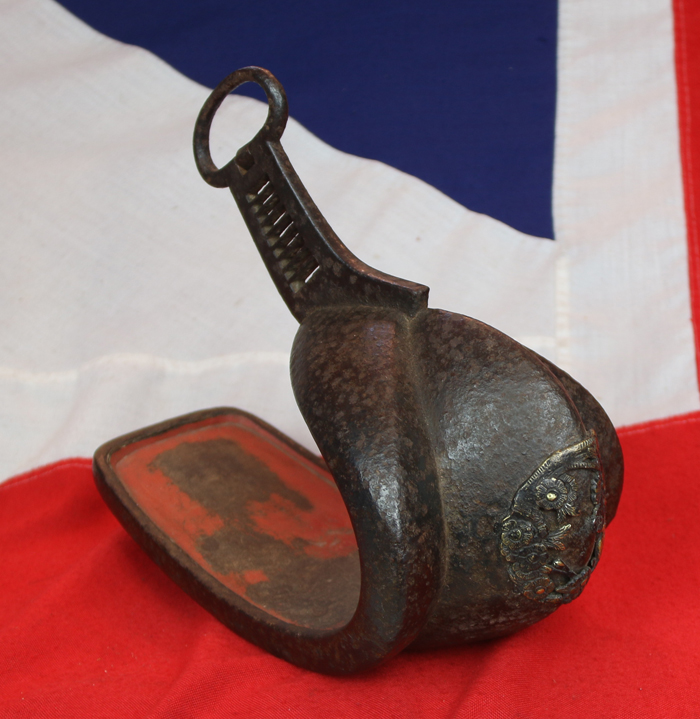
A Beautiful, Edo, Higo School of Armour. A 17th Century Samurai's Tetsu Abumi Stirrup, Clan Mon of Bird & Sakura Equestrian Armour of 'Mono no Aware', 物の哀れ, Protective Armour & Weapon To Kick Out At Foot Samurai While Galloping In Battle
Available
£1450.00
—
Description
This Japanese higo school armour stirrup, with a clan crest (mon) of a bird in a cherry blossom treee (sakura) 'mono no aware' 物の哀れ in sinchu , is made in the traditional dove's breast (hato mune) shape with an open platform lined with red lacquer, slightly curved forward so that the foot fits in without sliding backwards. In the front extremity the stirrup has a rectangular buckle with several horizontal slots which also serve as a handle.Not only a fine example of early original samurai equestrian combat armour, for protecting the foot of a mounted combat samurai in battle, it is also a weapon and a beautiful work of art. It also represents a most inexpensive collector's item of original samurai armour, combined as a weapon of combat and war, and around 400 years old.The whole surface is in ancient russetted iron in the distinctive Higo school style, with a large onlaid most decorative sinchu clan mon crest mount of a bird with sakura tree, the 'Mono no Aware'Cultural context for this samurai crest. In Japan, this image represents the concept of mono no aware (the pathos of things). 物の哀れ —a poignant awareness of the impermanence of life, as both the cherry blossoms and the birds' activity are intense but fleeting.It is to be noted as we previously detailed, that these stirrups, due to their weight, were also used as weapons against the enemy infantry samurai and ashigaru. A kick from this by the mounted samurai when riding past a standing samurai at full gallop would smash through even the strongest iron helmet kabuto, resulting in likely instant death. The same effect as hitting any object with a 12 pound steel club hammer at full swingAbumi, Japanese stirrups, were used in Japan as early as the 5th century, and were a necessary component along with the Japanese saddle (kura) for the use of horses in warfare. Abumi became the type of stirrup used by the samurai class of feudal Japan Early abumi were flat-bottomed rings of metal-covered wood, similar to European stirrups. The earliest known examples were excavated from tombs. Cup-shaped stirrups (tsubo abumi) that enclosed the front half of the rider's foot eventually replaced the earlier design.During the Nara period, the base of the stirrup which supported the rider's sole was elongated past the toe cup. This half-tongued style of stirrup (hanshita abumi) remained in use until the late Heian period (794 to 1185) when a new stirrup was developed. The fukuro abumi or musashi abumi had a base that extended the full length of the rider's foot and the right and left sides of the toe cup were removed. The open sides were designed to prevent the rider from catching a foot in the stirrup and being dragged.The military version of this open-sided stirrup, called the shitanaga abumi, was in use by the middle Heian period. It was thinner, had a deeper toe pocket and an even longer and flatter foot shelf. It is not known why the Japanese developed this unique style of stirrup, but this stirrup stayed in use until European style-stirrups were introduced in the late 19th century. The abumi has a distinctive swan-like shape, curved up and backward at the front so as to bring the loop for the leather strap over the instep and achieve a correct balance. Most of the surviving specimens from this period are made entirely of iron, inlaid with designs of silver or other materials, and covered with lacquer. In some cases, there is an iron rod from the loop to the footplate near the heel to prevent the foot from slipping out. The footplates are occasionally perforated to let out water when crossing rivers, and these types are called suiba abumi. There are also abumi with holes in the front forming sockets for a lance or banner. Seieibushi (Elite Samurai)Traditionally the highest rank among the samurai, these are highly skilled fully-fledged samurai. Most samurai at the level of Seieibushi take on apprentices or Aonisaibushi-samurai as their disciples.Kodenbushi (Legendary Samurai)A highly coveted rank, and often seen as the highest attainable position, with the sole exception of the rank of Shogun. These are samurai of tremendous capability, and are regarded as being of Shogun-level. Kodenbushi are hired to accomplish some of the most dangerous international missions. Samurai of Kodenbushi rank are extremely rare, and there are no more than four in any given country.Daimyo (Lords)This title translates to 'Big Name' and is given to the heads of the clan.Shogun (Military Dictator)The apex of the samurai, the Shogun is the most prestigious rank possible for a samurai. Shoguns are the leaders of their given district, or country, and are regarded as the most powerful samurai.Picture in the gallery of Samurai Wagakawa Kiyohide riding his black horse into battle wearing his identical black and brass mounted abumi horse armour stirrup.
Dealer Info
Dealer Info
-
 Brighton, East Sussex · United Kingdom