
1 / 10

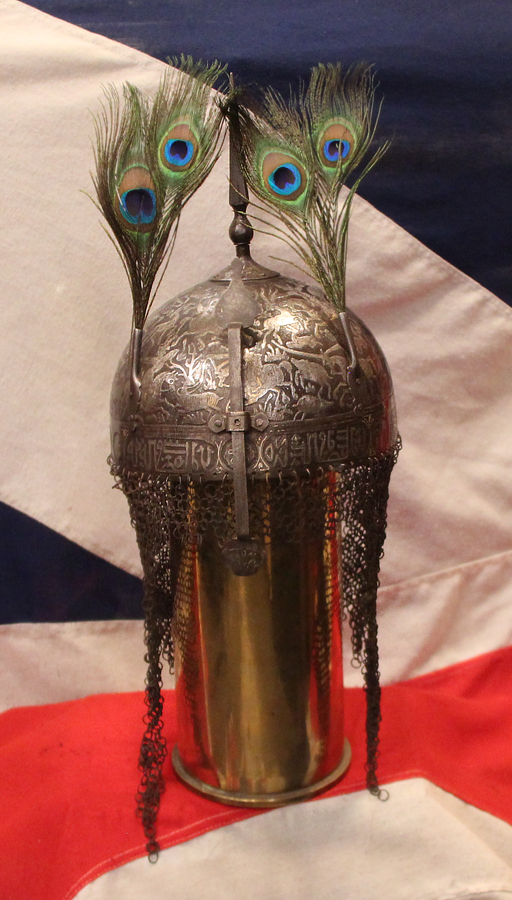
A Most Fine 18th-19th Century Indo Persian Khula Khud Helmet. One Of The Most Iconic Forms of Armoured Warrior Combat Dress in The World. A Form of Helmet Represented In Historical Texts & Illustrations Of The Holy Land Around 1000 Years Ago
Available
£1950.00
—
Description
The helmet has a hemi-spherical skull engraved throughout, the skull fitted at its apex with a high spike, a pair of plume-holders at the front and with a staple for a sliding nasal guard, decorated over the greater part of its surface with traces of gold koftgari of scenes of a hunt, and a band of koranic Islamic text, and mail neck-defence of butted links. Khula Khud helmets of this design originated in Central Asia, and this form were worn by Persian Empire soldiers in the 18th and 19th Centuries.Despite the similarity in their design, the Khula Khud helmets were decorated with a wide degree of variations depending on the cultures from which they were created. Decorations often appeared in the skull and the nasal bar, which were often heavily decorated with patterned motifs of inlaid brass, silver or gold; or decorated with figurative images.Some Mughal helmets feature calligraphic inscriptions from the Quran, supposedly to gain 'Help from Allah and a speedy victory.' Made of steel, these bowl-shaped helmets were designed as either low and flat, or high and pointed. They sometimes contained a spike socket such as this one, at the top of the helmet, which resembles a spearhead with a cross-like section.Two or three plume holders were attached on either side of the skull, used to mount feathers from birds such as the egret or peacock.As one can see their design was not only perfectly functional and effective for combat, but aesthetically, extraordinarily beautiful, and once fully armoured the Mughal warrior of the time would look incredibly impressive and remarkably intimidating.
Dealer Info
Dealer Info
-
 Brighton, East Sussex · United Kingdom