
1 / 10

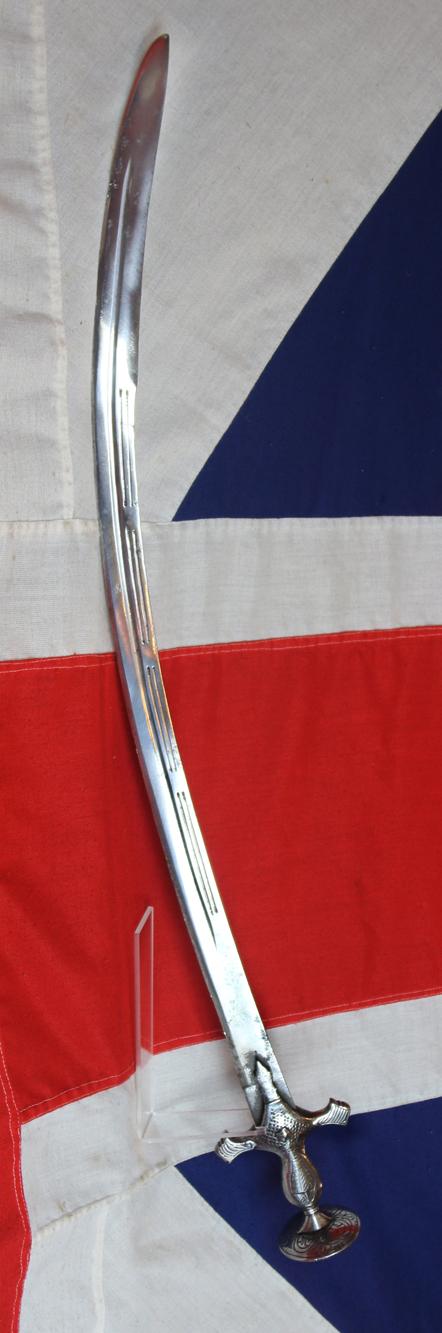
A Beautiful Mughul High Ranking Warrior's Sword Talwar 17th-18th Century, Likely Wootz or Damascus Kilij Form Blade
Available
£1495.00
—
Description
With fine chiselled steel hilt decorated with leaf design and blind fretwork, and a chiselled disc pommel. It has a superb, sharp, likely wootz or Damascus steel blade, with numerous chisel engraved fullers with a return 10 inch false edge at the tip.The talwar belongs to the same family of curved swords as the Persian shamshir, the Turkish kilij, Arabian saif and the Afghan pulwar, all such swords being originally derived from earlier curved swords developed in Turkic Central Asia. The average talwar typically does not usually have as radical a curve as the shamshir and only a very small minority have the expanded, stepped, yelman typical of the kilij, somewhat as this sword has.The talwar has a distinctive, all-metal, Indo-Muslim hilt was developed in Medieval western India. The increasing influence in India of Turco-Afghan, and later Turco-Mongol, dynasties (employing Persian and Central Asian arms) in the Late Medieval and subsequent eras led to ever greater use of sabre-like, curved swords. By Mughal times, the talwar had become the most popular form of sword in the Subcontinent. The talwar was the product of the marriage of the curved blade derived from Turco-Mongol and Persian swords and the native all-metal Indo-Muslim hilt.The Mughal empire was created and sustained by military warfare but also established new administrative practices and incorporated diverse ruling elites to produce an efficient, centralised, standardised rule. Akbar, the third Mughal emperor, instituted agricultural taxes which served as the base of the empire's collective wealth. These taxes, amounting to well over half of a peasant cultivator's output, had to be paid in money, and this impelled peasants and artisans to enter market networks so as to obtain it.Battles during Mughal Rule1st Battle of Panipat 1526 Babur defeated Ibrahim Lodhi establishing the Mughal Empire in India.Battle of Khanwa 1527 Babur defeated Rana Sunga of Mewar and his allies.Battle of Ghaghra 1529 Babur defeated the joint forces of the Afghans and Sultan of BengalBattle of Chausa 1539 Sher Shah Suri defeated Humayun2nd Battle of Panipat 1556 Akbar defeated Hindu king HemuBattle of Thanesar 1567 Akbar defeated two rival groups of SanyasisBattle of Tukaroi 1575 Akbar defeated Sultanatte of Bangala and BiharBattle of Haldighati 1576 Undecisive battle between Raja Man Singh of the Mughal army and Rana Pratap of MewarBattle of Samugarh 1658 Aurangzeb and Murad Baksh defeated Dara ShikohBattle of Khajwa 1659 Aurangzeb defeated his brother Shah ShujaBattle of Saraighat 1671 Lachit Borpukhan of Ahom kingdom defeated the Mughal army led by Ram Singh.Battle of Karnal 1739 Nadir Shah defeated Mughal Emperor Muhammad Shah and looted the Mughal treasury including Peacock throne and the Kohinoor diamondBurgeoning European presence in the Indian Ocean, and its increasing demand for Indian raw and finished products, created still greater wealth in the Mughal courts. There was more conspicuous consumption among the Mughal elite, resulting in greater patronage of painting, literary forms, textiles, and architecture, especially during the reign of Shah Jahan. Among the Mughal UNESCO World Heritage Sites in South Asia are Agra Fort, Fatehpur Sikri, Red Fort, Humayun's Tomb, Lahore Fort, and the Taj Mahal, which is described as the 'jewel of Muslim art in India and one of the universally admired masterpieces of the world's heritage
Dealer Info
Dealer Info
-
 Brighton, East Sussex · United Kingdom