
1 / 4

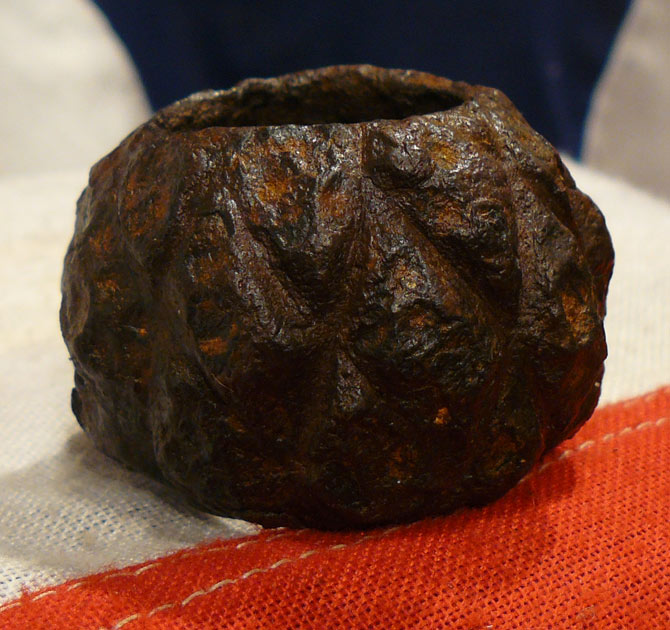
An Original Ancient 13th Century, Ancestral Crusader Knight's Iron Battle Mace & Scorpion Head. From The Site of the Battle of Crecy Fought on The 26 August 1346 Recovered in the 1800's During a 'Grand Tour'
Available
£875.00
—
Description
Pineapple shaped head with large mounting hole. The type as were also used as a Flail Mace, with the centre mount being filled with lead and then a chain mounted upon an inserted hook in the lead centre. Otherwise it was mounted upon a haft.It has flattened pyramidical protuberances around its whole surface and probably English made.Made for a mounted Knight in the era of the Crusades, to use as an armour smasher and a helmet crusher in mortal combat. Although made in the crusades era in the 1200's it would have been continually used up to the 14th century, up to and including the first decade of the hundred years war, at the Battle of Crecy, in 1346. We recently acquired some other beautiful pieces, from the descendant family of the 10th Duke of Hamilton, that their ancestors had purchased in the 1820's during a Grand Tour, from just north of the Mave River at Crecy.On a Flail it had the name of a Scorpion in England or France, or sometimes a Battle-Whip. It was also wryly known as a 'Holy Water Sprinkler'.King John The Ist of Bohemia used exactly such a weapon, as he was blind, and the act of 'Flailing the Mace' meant that his lack of site was no huge disadvantage in close combat. Although blind he was a valiant and the bravest of the Warrior Kings, who perished at the Battle of Crecy against the English in 1346. On the day he was slain he instructed his Knights both friends and companions to lead him to the very centre of battle, so he may strike at least one blow against his enemies. His Knights tied their horses to his, so the King would not be separated from them in the press, and they rode together into the thick of battle, where King John managed to strike not one but at least four noble blows. The following day of the battle, the horses and the fallen knights were found all about the body of their most noble King, all still tied to his steed.The Battle of Crécy took place on 26 August 1346 in northern France between a French army commanded by King Philip VI and an English army led by King Edward III. The French attacked the English while they were traversing northern France during the Hundred Years' War, resulting in an English victory and heavy loss of life among the French.The English army had landed in the Cotentin Peninsula on 12 July. It had burnt a path of destruction through some of the richest lands in France to within 2 miles (3 km) of Paris, sacking many towns on the way. The English then marched north, hoping to link up with an allied Flemish army which had invaded from Flanders. Hearing that the Flemish had turned back, and having temporarily outdistanced the pursuing French, Edward had his army prepare a defensive position on a hillside near Crécy-en-Ponthieu. Late on 26 August the French army, which greatly outnumbered the English, attacked.During a brief archery duel a large force of French mercenary crossbowmen was routed by Welsh and English longbowmen. The French then launched a series of cavalry charges by their mounted knights. These were disordered by their impromptu nature, by having to force their way through the fleeing crossbowmen, by the muddy ground, by having to charge uphill, and by the pits dug by the English. The attacks were further broken up by the effective fire from the English archers, which caused heavy casualties. By the time the French charges reached the English men-at-arms, who had dismounted for the battle, they had lost much of their impetus. The ensuing hand-to-hand combat was described as 'murderous, without pity, cruel, and very horrible.' The French charges continued late into the night, all with the same result: fierce fighting followed by a French retreat.The English then laid siege to the port of Calais. The battle crippled the French army's ability to relieve the siege; the town fell to the English the following year and remained under English rule for more than two centuries, until 1558. Crécy established the effectiveness of the longbow as a dominant weapon on the Western European battlefield.The 2009 Encyclopædia Britannica uses the figures of about 6,000 for the English and 20,000 to 30,000 for the French. Part of an original medieval collection we have just acquired, of Viking and early British relics of warfare some from ancient battle sites recovered up to 220 years ago.
Dealer Info
Dealer Info
-
 Brighton, East Sussex · United Kingdom