
1 / 9

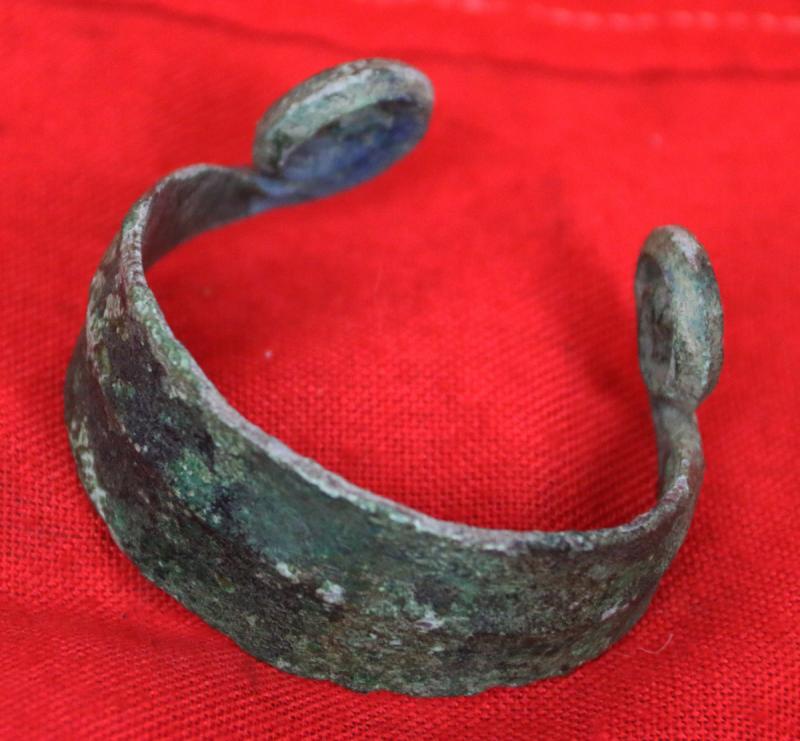
A Remarkably Beautiful & Elegant Proto Celtic Bronze Age Bracelet Circa 2600 Years Old. That Continued Use Into Era Of The Great Iceni Celtic Queen Boudica. And, The Bracelet That Inspired Gustav Klimt One Of The Greatest Art Nouveau Artists In The World
Available
£995.00
—
Description
This is an original Celtic 2600 year old bronze serpentine ringed cuff bracelet, 'object vertu' that was directly copied by one of the greatest Art Nouveau artists in the world, Austrian, Gustav Klimt leader of his Art Nouveau Jugendstil Vienna Secession Movement. Gustav Klimt's painting 'Dame Mit Fächer' (Lady with a Fan) sold at Sotheby's in London, in 2023 for $108.4 million. See photo in the gallery of the {circa 1895} Jugendstil Vienna Secession bracelet, an obvious direct copy.From the 8th to 6th centuries BC, developing out of the Urnfield culture of the 12th century BC (Late Bronze Age) and followed in much of its area by the La Tène culture. It is commonly associated with Proto-Celtic speaking populations.By the 6th century BC, it had expanded to include wide territories, falling into two zones, east and west, between them covering much of western and central Europe down to the Alps, and extending into northern Italy. Parts of Britain and Iberia are included in the ultimate expansion of the Celtic culture. Where the snake serpentine designs of jewellery and adornments continued into Ancient Britannia, and the realm in Norfolk of the greatest and most famous Iceni Queen, Boudica, scourge and destroyer of the 70,000 to 80,000 Britannia based 9th Legion of Rome and their pro Roman supporters, in 61 A.D. In the Roman towns of Camulodunum, Verulamium, and Londinium.This bracelet was the direct inspiration, but actually it is clearly an identical copy, for Gustav Klimt'sArt Nouveau Jugendstil Vienna Secession, brass cuff braceletSee the gallery the stunning Gustav Klimt Jugendstil Vienna Secession brass cuff bracelet, circa 1895, currently offered by exclusive jewellery and object vertu dealers DFS in New YorkSale price $5,500.00.The history of the evolution of the Celts from their Austrian originsIn German historiography, these seats of power are called fürstensitz. These were large, fortified hill forts situated on easily defendable locations. There were at least 16 such seats of power, while there were probably more just waiting to be discovered. The most important ones were at Hochdorf, Wurzburg, Heuneburg, Hohenasberg, Breisach, Mont Lassois, Vix, and Camp de Chassey, amongst others. These fortified settlements were protected by a complex system of ditches and earthen ramparts.Most modern scholars and historians associate the culture with the Celts. It is commonly understood that this intriguing culture was the foundation from which emerged the wondrous Celtic world that we all know so well. In many aspects, this was is clearly the earliest, Proto-Celtic stage in Bronze and Iron age Europe.2,25 inches across, 1 inch high.For reference see; Stead, I. M. (1997). Celtic Art. Harvard University Press
Dealer Info
Dealer Info
-
 Brighton, East Sussex · United Kingdom