1 / 2

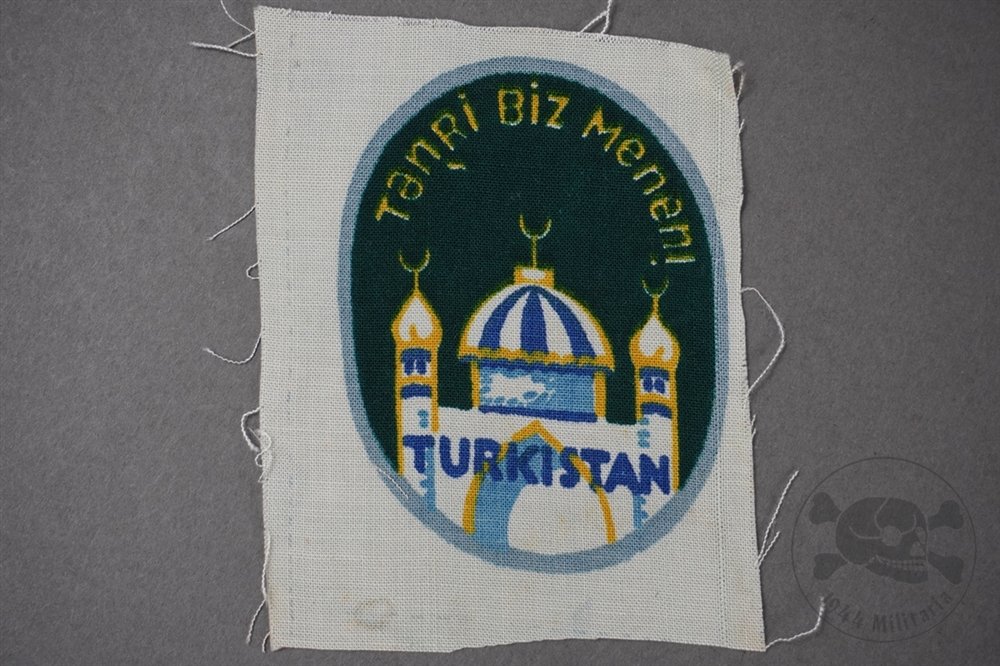
Original German WWII Turkistan Volunteer's Sleeve Shield (Turkistan Landesschild)
Available
$52.00
—
Description
Original German WWII Turkistan Volunteer's Sleeve Shield (Turkistan Landesschild)-Following the launch of Operation Barbarossa on June 22, 1941, German forces encountered various non-ethnic Russian groups—many of whom welcomed the Wehrmacht as liberators from Soviet rule. Despite Hitler's deep mistrust of their ethnic origins and loyalty, frontline commanders recognized the strategic advantage of employing these volunteers, particularly amid increasing manpower shortages. By the summer of 1941, non-ethnic Russian POWs and volunteers were being utilized in labor and logistical support roles, often against Hitler's direct orders.To secure allegiance from Turkistani volunteers, Hitler authorized the creation of the *Turkistan Legion* in November 1941, which operated under the command and training of the German 162nd Infantry Division. In the autumn of 1942, a distinctive national sleeve shield was introduced for Legion members. This insignia underwent two redesigns: first in September 1943, and again in mid-1944. Notably, early versions of the badge used Arabic script—despite Arabic not being spoken in Turkistan—sparking backlash. The third and final version sought to correct this by using ancient Jagatai script, though it too was outdated and no longer in practical use.This is the third and final pattern of the *Turkistan Legion Sleeve Shield*, introduced in mid-1944 and worn until the end of the war. The shield is a vertically oval, screen-printed insignia measuring approximately 75mm tall by 60mm wide. It features a fine light blue outer border surrounding a stylized mosque dome in blue, white, and golden yellow, flanked by two minaret-topped spires, all set against a dark green field. The mosque motif is overprinted with the word *'Turkistan'* in bold blue Latin script, while the top edge bears the Jagatai Turkic inscription *'T ri biz menen!'*, translated as *'God with us!'*, in yellow.A historically and visually striking foreign volunteer insignia, representative of the complex and often contradictory alliances formed during the war.
Dealer Info
Dealer Info
-
 Woolwich, NJ · United States