1 / 2

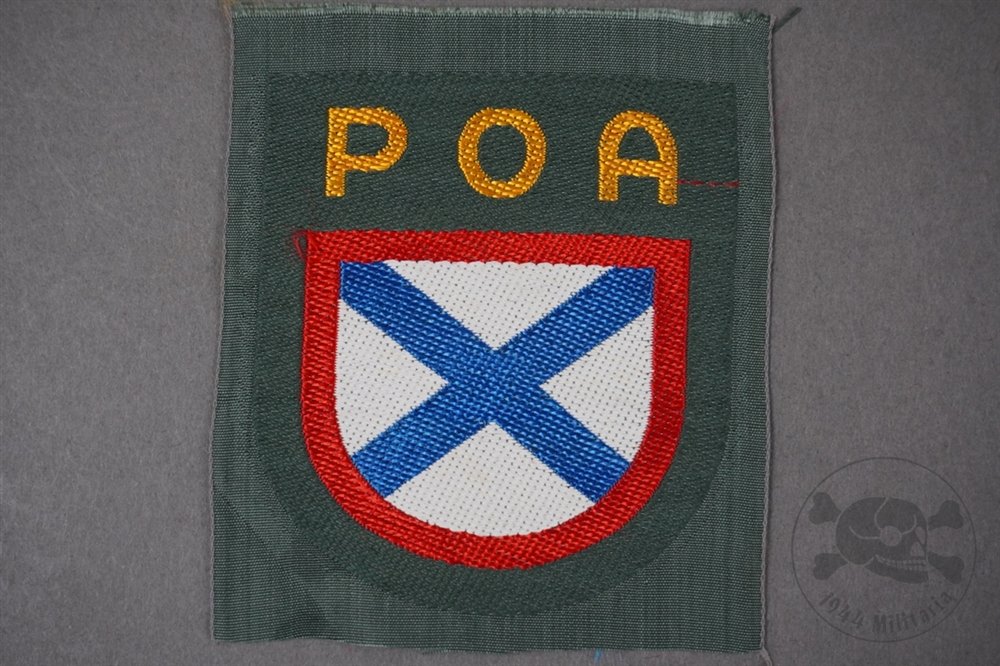
Original German WWII Russian POA Volunteer Sleeve Shield 1st Pattern
Sold
$70.00
—
Description
Original German WWII Russian POA Volunteer Sleeve Shield 1st Pattern-With the launch of Operation Barbarossa on June 22, 1941, German forces encountered numerous non-ethnic Russian groups who viewed the Wehrmacht as liberators from Soviet rule. Although Hitler remained deeply suspicious of their ethnic background and political loyalty, German field commanders quickly recognized the practical advantage of employing these volunteers in non-combat roles, especially in light of growing manpower shortages. By mid-1941, non-ethnic Russian POWs and volunteers were already being used in rear-area labor and logistical support roles—often in direct defiance of Hitler's orders.By 1943, the worsening military situation forced Germany to begin accepting ethnic Russians into service. To capitalize on anti-communist sentiment, Hitler authorized the creation of a propaganda committee led by captured Soviet General Andrey Vlasov—formerly commander of a Soviet army at the Leningrad Front, captured on July 12, 1942. As head of theSmolensk Committee, Vlasov issued a proclamation on December 27, 1942, calling on Russians to overthrow Stalin, seek peace with Germany, and join a new anti-communist European order.The response was significant, prompting the formation of theRussian Army of Liberation(Russkaia Osvoboditel'naia Armiia – ROA) in early 1943. Despite initial resistance, Hitler finally sanctioned the force on November 14, 1944. Alongside official recognition came the issuance of identifying insignia, including the POA sleeve shield.This is an original, machine-woven POA sleeve shield inexcellent, unissued condition, still attached to a portion of its original field-grey rayon factory roll. The shield features a flat-topped, rounded-bottom design with a red outer border enclosing a central white field bearing the blue Cross of St. Andrew—the patron saint of Russia. Above the cross are golden-yellow Cyrillic letters 'РОÐ' (appearing as 'POA' in Latin script), denotingRusskaia Osvoboditel'naia Armiiaor Russian Army of Liberation.A historically significant foreign volunteer insignia tied to one of the most complex and politically charged collaborationist forces of the war.
Dealer Info
Dealer Info
-
 Woolwich, NJ · United States