
1 / 24

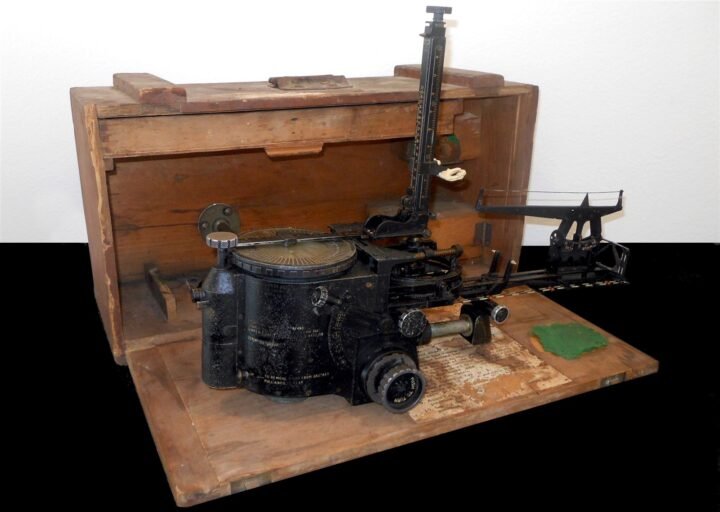
WW2 RAF RCAF Bomber Aircraft Course Setting Bomb Sight MK IX E – Mosquito etc.
Available
$1799.99
—
Description
You are bidding on a VERY NICE and BOXED example of a WW2 RAF / RCAF British Canadian Mk. IX A Course Setting Bombsight! This type was used in the Avro Lancaster, Vickers Wellington, Short Sterling, De Havilland Mosquito, Bristol Beaufort, and Bristol Beaufighter!The Course Setting Bomb Sight (CSBS) is the canonical vector bombsight, the first practical system for properly accounting for the effects of wind when dropping bombs. It is also widely referred to as the Wimperis sight after its inventor, Harry Wimperis. The basic design was adapted by almost all air forces and used well into World War II. It was eventually replaced in British service by the more advanced designs like the Mark XIV bomb sight and the Stabilized Automatic Bomb Sight. Other services used vector bombsights throughout the war.When an aircraft flies in the presence of wind, its flight path over the ground is a function of the aircraft's airspeed, heading, and the speed and direction of the wind. These are combined using basic vector addition to return the course made good or track. These calculations are a basic part of air navigation and dead reckoning, taught to all aviators. Using the vector calculator and basic measurements, one can easily calculate the winds aloft and then the course made good. These calculations are identical to those needed to properly account for the effects of winds on the bombing approach. The problem was that these calculations were complex, time consuming and error prone. Wimperis decided to attack the calculation problem by incorporating a similar vector calculator directly into the bombsight, combining it with a drift measure similar to the one from the earlier Drift Sight. Like the Drift sight, simply taking a measure of the wind using the sight itself provided all of the unknown variables needed to complete calculate the bombing approach.Unlike the Drift Sight, the new design not only calculated the effect on the distance the bombs travelled, but also indicated the proper direction to fly to approach the target so the aircraft reached it with no residual sideways motion – thereby cancelling any drift, no matter the approach direction. His new Course Setting Bomb Sight featured a large compass at the rear that could be used for making general calculations of wind speed or solving navigational problems. In most cases these could be ignored; the bomb aimer dialed in the wind direction on the compass, then wind speed, airspeed and altitude on different knobs. Through internal mechanisms, these adjustments carried out all of the calculations needed to set the approach and range angle. Through these calculations the CSBS allowed bombing from any direction, freeing the aircraft from the wind line for the first time.The new Mk. X replaced the vertical slider used for altitude adjustment with a horizontally-moving backsight at the top of the device, and the entire foresight and drift wire area was made considerably smaller. The calculator and wind drift settings, formerly mounted on top and in front of the large compass at the rear of the earlier models, was moved to the left side of the device and changed in form to make it smaller as well. The compass, no longer containing pointers and dials, was replaced with a smaller unit. The result was a version of the CSBS that was much smaller than earlier versions. About 5,000 of the new Mk. X were built and awaiting fitting to aircraft at the opening stages of the war. After the disastrous raid on Wilhelmshaven in 1939, the RAF was forced to abandon daylight attacks and move to night bombing. The Mk. X proved to have very poor visibility at night, and it would be difficult to modify it to correct this problem. The Mk. X had to be abandoned, and Mk. VII's and Mk. IX's hurriedly re-fit to aircraft. Thus the older versions of the CSBS soldiered on long after they were due to be replaced, and remained the primary British bombsights into 1942. The Mk. VII was widely found on slower aircraft and training schools, while the Mk. IX was used in higher speed aircraft.Made of aluminum, steel, and glass, and dating around 1943, this is a VERY NICE example. Though there are some scratches, wear, and dirt from storage, it retains MUCH of its original finish! All the parts are original to this sight, and the data information is 100% intact, clearly indicates the model and type. Appears to be complete and mechanically functional. Comes in the original storage chest, along with a complete set of scales and other small parts. The extra compass (usually stored in the right side of the crate) is missing, but that is fairly common, and they come up on eBay quite a bit if someone wishes to replace it. Locking latches on the chest have broken away. I have shown this exact type in use in the last photo. Would make an EXCELLENT addition to any collection, display, or simply as a conversation piece!
Dealer Info
Dealer Info
-
 Thousand Oaks, CA · United States