
1 / 12
WW2 German Wehrmacht W.Gr.36 – 5.0 CM MORTAR ROUND w/ BAKELITE FUSE – Le.Gr.W.36 BARN FIND – VERY NICE!
Available
$299.99
—
Description
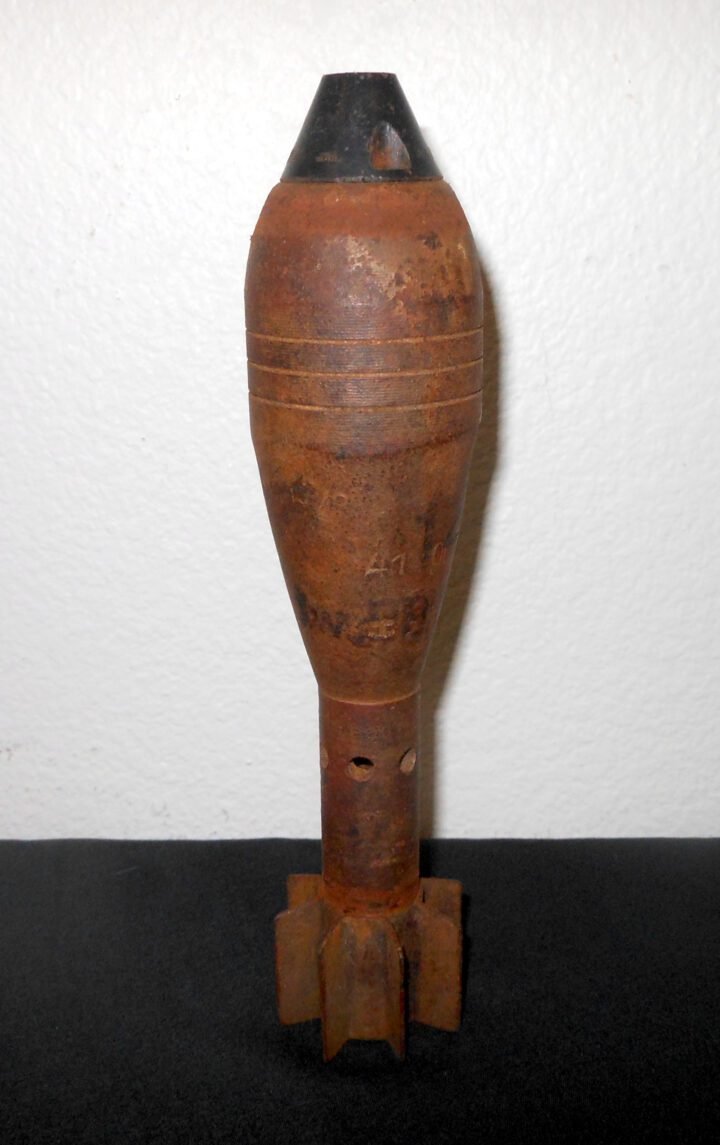
You are bidding on an EXCELLENT and 100% INERT barn-find example of a WW2 German Wehrmacht 5,0cm le.Gr.W.36 (Leichter Granatwerfer 36) High Explosive Mortar Round!Designated Wurfgranate 36, the round was a steel body and either a metal or bakelite percussion fuse. Production ceased in 1943 as heavier mortars proved more effective, but the W.Gr.36 remained widely used until war's end.The 5 cm leichter Granatwerfer 36 (5 cm leGrW 36) was a light mortar used by Nazi Germany during World War II. The mortar's development was started in 1934 by Rheinmetall-Borsig AG and it was adopted for service in 1936. Its intended role was to engage pockets of resistance that were beyond a hand grenade's throwing range. Until 1938, it used a complicated telescopic sight. By 1941, the Granatwerfer 36 was seen as too complex for its intended role, the shell was too light and the range too short. It was used as a platoon mortar and operated by a 3-man team.Production was terminated in 1941. By 1942, it had been gradually withdrawn from front line service. However, it remained in use with second-line and garrison units until the end of the Second World War in 1945. As ammunition stocks for the mortar dwindled during 1944–1945, coupled with the loss of the actual mortars, the Germans often relied on captured French and Soviet 50mm mortars. The 50 mm continued to be popular for the remainder of the war, simply because it was easily transported by two men, and provided infantry with hitting power and a range capability greater than any other weapon readily available at the squad or section level. A total of 22,112,000 rounds of ammunition were produced for the weapon from 1939 to 1943.Made of a steel, this L.Gr..W.36 Mortar Round is in VERY NICE barn-find condition! Retaining 95% original wartime paint, with patina throughout, including areas of rust, oxidation, and light scaling consistent with long-term exposure. It is dated 1941, and features various waffenamts and inspection stamps, indicating,41 gum 28.The bakelite fuse is marked227 Wgr ZT fek 42.The body is manufactured from 4mm thick mild steel,features a finned tail consisting of 8 blades,and measures approximately 8.5″ inches in overall length. This piece has not been restored or refinished, so it could use a bit of a clean-up. Would make a PERFECT item for any collection or display!
Dealer Info
Dealer Info
-
 Thousand Oaks, CA · United States