
1 / 10

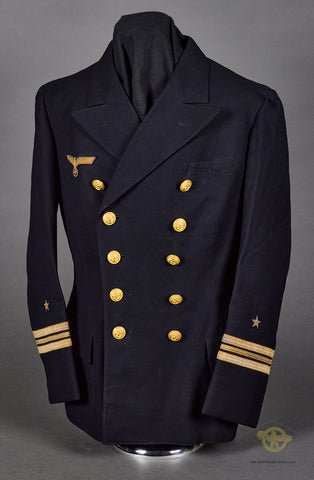
Kriegsmarine Knights Cross Winner Officer Reefer Jacket
Sold
$4100.00
—
Description
Kriegsmarine Knights Cross Winner Officer Reefer Jacket-This jacket belonged to the first officer from a Schnellbootwaffe to be awarded the Knight's Cross of the Iron Cross on May 16th, 1940, Korvettenkapitan Hermann Opdenhoff. Here is a full biography that I took directly from Wikipedia. Very interesting stuff!Hermann Immanuel Opdenhoff (born January 9, 1915 in Falkenberg, Osterburg district ; killed in action March 22, 1945 in the Den Helder, Holland, lock) was a German naval officer, ultimately a lieutenant commander (KJorvettenkapitan) in the Kriegsmarine. He was the first officer of the Kriegsmarine's fast-attack craft division to receive the Knight's Cross of the Iron Cross.Life:Hermann Opdenhoff was the son of Pastor Johannes Opdenhoff and joined the German Navy on 8 April 1934. He was assigned to infantry training in the 2nd Company of the II. Schiffsstammabteilung (Shipping Department) of the Baltic Sea. From 15 June 1934 to 27 September 1934, he was on board the Gorch Fock for on-board training, then until 27 June 1935, he was on board the Emden for practical on-board training.He was then assigned to the Naval Academy in Mürwik for a warrant officer course until February 17, 1936. As part of his warrant officer training, he spent a couple of days on a navigation instruction cruise on the steamer Hecht. He was transferred to the Naval Artillery School for a warrant officer artillery course until June 3, 1936. He was promoted to ensign on July 1, 1935. He then transferred to the Torpedo School in Mürwik for a torpedo course until July 22, 1936, and then to the Naval Intelligence School in Mürwik for a communications course. This was followed by a blocking course at the Blocking School in Kiel from August 12, 1936, to September 2, 1936.In September 1936, he again served in the 2nd Baltic Sea Fleet. From September 30, 1936, to May 15, 1938, he was promoted to lieutenant on April 1, 1937, and again for practical onboard training on the Emden. In the meantime, he attended a diving course with the 1st Baltic Sea Fleet and was posted as a company officer to the 4th Baltic Sea Fleet on September 25, 1938. He was posted on the Asta from July 29, 1938, to August 20, 1938, as an overdue duty officer.From 26 September 1938 he was commander of a fast-boat in the 2nd Fast-Boat Flotilla, came to a torpedo boat course at the Torpedo School Mürwik and took over S 31 at the beginning of July 1939. On 10 May 1940, according to initial information from the Naval War Command (SKL), S 31 sank an enemy destroyer, the British Kelly , while securing a mine-laying formation in the North Sea , and the SKL war diary notes:'The first glorious success of our fast-deployment boat weapon, which deserves particularly high marks for its deterrent effect on the enemy.'On May 15, 1940, the SKL war diary relativized the alleged sinking and stated, based on 'subsequent radio decryption,' that the destroyer was towed to the English coast and that a sinking could not be confirmed.For the sinking of the Kelly, he was awarded the Knight's Cross of the Iron Cross on 16 May 1940 as the first officer of the Kriegsmarine's fast-boat division.On 23 June 1941, he sank the Soviet patrol boat MO 238 with S 44. Until June 1942, he was commander of various fast-boats in the 2nd Fast-Boat Flotilla.With the establishment of the Schnellboot Training Flotilla in July 1942 in Swinemünde, he was entrusted with the duties of the flotilla commander. On 25 January 1943, he became flotilla commander. In early November 1943, the Schnellboot Training Flotilla was expanded to become the Schnellboot Training Division, with Opdenhoff remaining as commander. In this position, he was promoted to Korvettenkapitän on 1 March 1943. In February 1944, he handed over command to Korvettenkapitän Klaus Feldt. In a ring exchange, he took over Feldt's former command and became commander of the 2nd Schnellboot Flotilla.On the night of 22 March 1945, the 2nd S-Boat Flotilla was scheduled for a torpedo mission off Great Yarmouth and had already begun its approach with three S-Boats when S 210 developed engine problems. Opdenhoff therefore decided to turn back and was attacked in the Den Helder lock by British Mosquito bombers of the 236th RAF Squadron. S 181 was hit by the bombs and the torpedoes carried in the boat detonated. S 181 sank and Opdenhoff, along with other crew members of S 181, was killed.This is his reefer jacket. It is produced in navy blue ribbed wool. It is in extremely fine condition with little to no visible wear or damage. Each sleeve has three gold tresse rings and a handsome gold bullion star. It is double breasted, with two rows of five large gilt naval type buttons. There are hip pockets and a small pocket on the left upper breast. There is a fantastic gold bullion breast eagle with bright gold flat wire highlights over a dark navy blue wool backing. All insignia is period attached. There are loops for a ribbon bar as well. The interior is fully lined in black silk that is excellent. There are pockets on each side. The pocket on the right side has a tailor tag with the name etc. The tailor tag in the pocket as well as in the neck reads Marineoffizierkleiderkasse Kiel. The jacket fits like a medium/large. It is excellent and for a very prominent and well known officer!
Dealer Info
Dealer Info
-
 Hubbardston, MA · United States