
1 / 8

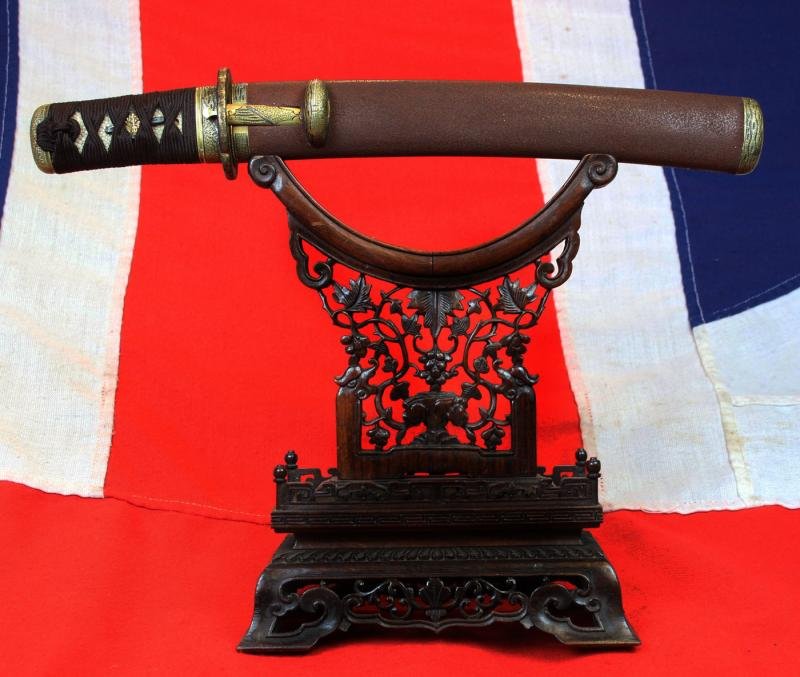
A Truly Beautiful Antique Koto Period, 'Dragon Head' Hamon, Unokubi (鵜首) Zukuri Blade Tantō. In a Chesnut and Sable Livery, Matsushiro Sinano Koshirae With Kozuka and Kogai, with Higo Scool Tsuba Inlaid With Pure Gold Sakura {Cherry Blossom}
Available
£4950.00
—
Description
Mounted with a fully matching suite of sinchu and contrasting silver line mounts, including the kozuka and kogai of the fine Matsushiro Sinano school. The Edo period iron tettsu Higo school tsuba is inlaid with pure gold cherry blossom. A very similar Higo school tsuba can be seen in the Osafune sword Museum in Japan, mounted upon a Tomonari, Sukesada blade tanto sword.The kozuka and kogai pockets in the saya are lined with delicate, doe skin, decorated with a black and red pattern, on a natural white skin ground, in the same form as can see seen to embellish kabuto and armour {see photo 8 in the gallery}.Wonderful chessnut brown ishime stone finish lacquer saya, with a contrast of sable brown tuskaito silk binding, wrapped over pure gold kiri mon menuki, on shakudo bar ground, over traditional samegawa {giant rayskin}.The stunning blade has a beautiful intricate hamon, including, where the yakiba meets the hada the detailed head of a dragon. A very small combat surface mark to one side of the blade, likely made by a blade tip {see both detailed in photo 10}.Unokubi (鵜首): An uncommon tantō style akin to the kanmuri-otoshi, with a back that grows abruptly thinner around the middle of the blade; however, the unokubi zukuri regains its thickness just before the point. There is normally a short, wide groove {hi} extending to the midway point on the blade, this is a most unusual form of unokubi zukuri blade tanto without a hi.Historically significant and intricately crafted, Japanese swords offer a unique glimpse into Japanese society. Compared to traditional Japanese blades, the Tanto stands out for its beauty, adaptability, and rich cultural importance. But of course, not everyone is well-familiar with this samurai sword form. Despite being traditional dagger sized all Japanese blades are titled as swords however short they may be.The Matsushiro Shinano Koshirae is a distinctive style of antique Japanese sword mounting (koshirae) that originated in the Matsushiro domain of Shinano Province (present-day Nagano Prefecture) during the Edo period. This style is specifically characterized by the use of brass (shinchu) for all of its metal fittings.Key CharacteristicsThe defining feature is the uniform use of brass for all components of the sword furniture, including the fuchi (hilt collar), kashira (pommel), tsuba (handguard), kojiri (scabbard tip), kozuka (small utility knife handle), and kogai (spike).These fittings often feature intricate decorations, such as bamboo or other natural patterns, sometimes with silver striping or designs.Matsushiro was a castle town developed by the Sanada family in the early Edo period. It is believed that many domains developed their own distinct styles of koshirae during this era, and the Matsushiro koshirae was a local specialty.The koshirae was the ornate, functional exterior of a samurai's sword, designed for both aesthetic appeal and practical use, in contrast to the plain wooden shirasaya used for storage.Swords with original Matsushiro koshirae are considered unique historical artifacts and are highly valued by collectors for their complete, matching sets of fittings.For example one of the great tanto swords of samurai history is 'Tanto Mei Bishu Osafune Jyu Nagayoshi' (短刀 銘 備州長船住長義) it is a tanto made by the swordsmith 'Osafune Nagayoshi' (Osafune Nagayoshi / Chogi) who was active in Bizen Province (currently eastern Okayama Prefecture) during the Nanbokucho period. This tanto was a favorite of Toyotomi Hideyoshi, and later it was received by Toyotomi's retainer 'Maeda Toshiie' at Osaka Castle (Osaka Castle), and since then it has been handed down to the Maeda family of Kaga Domain, making it a prestigious famous sword.The swordsmith, Osafune Nagayoshi, is one of the 'Osafune Four Heavenly Kings' representing the 'Osafune School', a group of swordsmiths that flourished in Bizen Province, and is also listed among the 'Masamune Jittei' (Masamune's Ten Disciples), the ten high disciples of the swordsmith Masamune, who is called the 'Ancestor of the Revival of Japanese Swords'.Photo in the gallery of a Tanto sword, by Sadamune, Kamakura period, 1300s AD - Tokyo National Museum - Ueno Park, Tokyo, Japan. This shows how their samurai swords are displayed in the greatest Japanese museum in Tokyo. The koshirae {fittings} are always shown separately, if at all.The antique Chinese display stand the tanto is shown upon is a superb hand carved hongmu hardwood piece, Ching Dynasty, and originally displayed a piece of the of finest Chinese Imperial Jade once featured in a Mandarin's palace in Peking, and you will see it featured throughout our online Japanese sword gallery to display wakazashi and tanto. It isn't for sale as it has been used by the family in our gallery for around 100 years.Over the centuries some extraodinarily talented bladesmiths have integrated within their blades a form of identfiable mark, one smith creates rabbit ears in his hamon, several others feature the profile of Mount Fuji, and even one features Mount Fuji with birds flying over head. This smith has created a dragon's head into his hamon, with utterly remarkable skill. It is possible you may never ever see another surviving example.Overall 13.5 inches long, blade 8.25 inches long tip to tsuba.
Dealer Info
Dealer Info
-
 Brighton, East Sussex · United Kingdom