
1 / 10

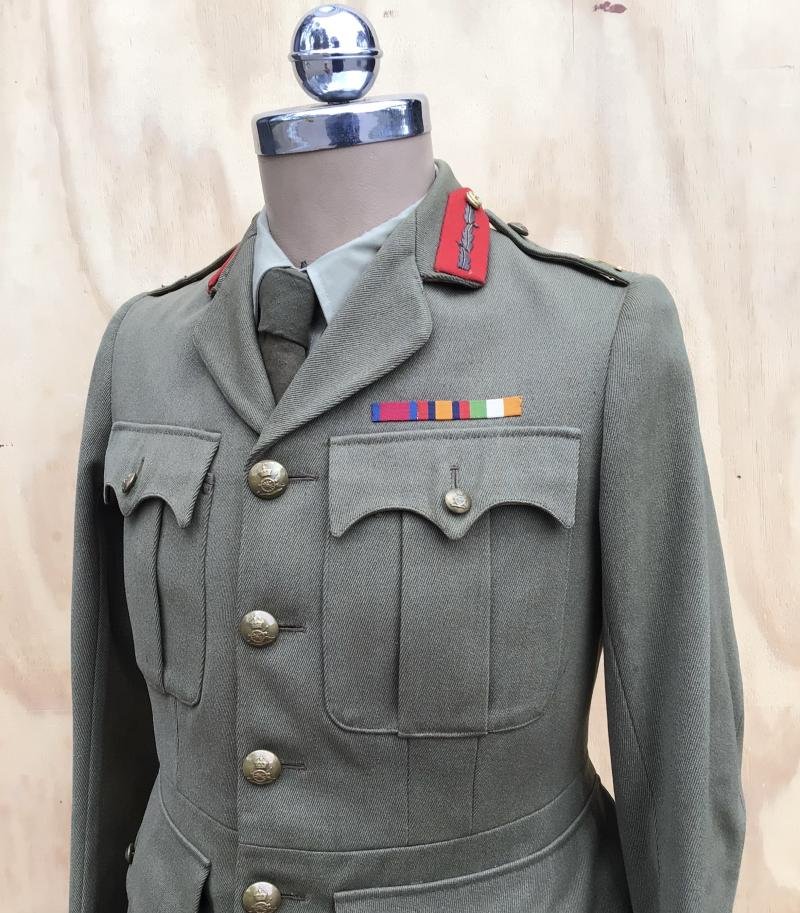
WW1 Named British Artillery General's Tunic
Available
A$2500.00
—
Description
Named to General Charles George St Maur Ingham.A lovely looking and well tailored officers four pocket service dress tunic in khaki wool whip cord. Has shoulder rank for Brigadier General c.1917, the shoulder straps with holes from previous lower ranks. To the front, brass Royal Artillery buttons. There is many notable examples of General Officers wearing the regimental buttons of their previous corps or regiments instead of the crossed sword and batton ones allotted to General Officers. Three place sewn on ribbon bar and Generals collar Gorgettes with small brass General Officers buttons. Full cotton lining with London tailors label named to then Major Charles George St Mair Ingham and dated 1915.There is a very interesting thread posted on the War Relics Forum from a former owner of this tunic and he has done some in-depth research notes on the the Generals life and how he had resorted the tunic rank back to its wartime configuration. The ribbon bar has also been repaired to also accommodate the one worn during the war omitting any other post war awards.I've have posted this all below and reference the fine work the previous owner has done on the War Relics forum post.General Charles George St Maur Ingham was born in the Parish of St George Hanover Square, Middlesex, England (now City of Westminster, London) on 5 September 1873. His parents were James Penrose Ingham and Lady Caroline Margarite Stanhope. The youngest of three children, he was fairly typical of the British 'officer class' of the period, born into a wealthy family and receiving a good education. I found a reference of his time at Eton College in the book Eton in the Eighties by Eric Parker which states: 'On the Collegers' side, in these two years, the names in the record of the war are not so frequent. In 1889 C. G. St. Maur Ingham played goals, and ten years later served with his battery in South Africa'.The London Gazette for 5th March 1895 records his commission into the RA from the Royal Military Academy, Woolwich: 'Gentleman Cadet Charles St Maur Ingham, from the Royal Military Academy, to be Second Lieutenant in succession to Lieutenant A. F. S. Scott, seconded. Dated 1st March, 1895'.Second Boer WarThe next references to him I have found are from the Boer War. He is listed on the roll for T Battery, Royal Horse Artillery, which must have been his original unit.His entry on the medal roll for the Queen's South Africa Medal confirms that he qualified for the following clasps, which give a general indication of his service: Relief of Kimberley (February 1900), Paardeberg (February 1900), Dreifontein (March 1900), Johannesburg (May 1900), Diamond Hill (June 1900) and Belfast (August 1900). The remarks column on the right notes that Captain C St M Ingham transferred on 1st March 1901 to the '1-Pr Maxims', a Royal Field Artillery unit. This is confirmed by this second QSA Medal Roll for a unit entitled 1-Pr Maxims RA (Pom-Poms). These 1-Pr Maxims were new weapons, basically a 37mm machine gun (known as a Pom-Pom from the sound it made) and, despite later being classed as an anti-aircraft weapon, it was used against infantry in South Africa.The next reference I have for him is another Gazette entry from 10th September 1901, when he was 'mentioned in despatches' (the first of 5 MIDs that I have found).His entitlement for the King's South Africa medalThis last roll gives his unit as 116th Battery, Royal Field Artillery, which I am assuming was his unit after the 1-Pr Maxims. After the Boer War, he married his wife, Phyllis Geraldine Betton-Betton-Foster on 29 September 1903. They had one daughter, Geraldine St Maur Ingham.At the start of the Great War, Ingham was a Major and went over with the British Expeditionary Force, arriving in France on 20th August 19143rd Div were involved with most of the major actions of 1914, including the battles of Mons, the Marne and First Ypres.The next reference I have for him would be the date on the jacket itself, October 1915, which would suggest he was on leave at the time and took the opportunity to acquire some new equipment. The copy of the Army List I have for Dec 1917 records that he was promoted to Lieutenant-Colonel in April 1916:Royal Regt of Artillery, Royal Horse and Royal Field Artillery, Lt-Colonels, Ingham C St M, DSO, 13 Apr 16By November 1916, he was back at the front earning another MID, which was gazetted in 1917The London Gazette of 29 December 1916, confirms his award of the Distinguished Service Order (DSO). One of the cards from his last two Mentions in Despatches give his unit as 71st Brigade RFA:71st, or more properly, LXXI Brigade RFA, was one of the artillery units of 15th (Scottish) Division, a New Army division of 'Kitchener men', and as a Lt-Col, he would have been the Commanding Officer. Transfers like this were not uncommon for New Army units. Although the New Army had been trained, and it's 'civilians in uniform' nature made it a very innovative force, it lacked any real experience, and the swapping out of units, formation and officers from the Regular Army and Territorial Force, provided some of this. I suspect this is the reason for his being moved to a New Army unit.His entry in the Army List for Dec 1918 shows he was moved up further:Royal Regt of Artillery, Royal Horse and Royal Field Artillery, Lt-Colonels, Ingham C St M, DSO, (temp Brig-Gen) s, 13 Apr 16And so at some point he was made temporary Brigadier-GeneralOn the 'Correspondence' side he is noted as being 'GOC 15th Div Artillery HQ', i.e. General Officer Commanding 15th Division Artillery HQ, a position more commonly called the CRA (Commander, Royal Artillery). Due to the fact that he forwarded a roll of names for award of the 1914 Star in December 1917, and that he is listed in the Dec 17 Army List as a Lt-Col, it can be surmised that his promotion to CRA must have been around this time.Post-WarThe London Gazette of 31 December 1918 has Charles St Maur Ingham in the 1919 New Year's Honours List, receiving the Companion of the Order of Saint Michael and Saint George (CMG). The edition for 21 Jul 1919 also names him as receiving the French decoration of the Legion d'Honneur, Officier. On 30th October 1919 he is again mentioned as being 'restored to the establishment' as a 'Supernumerary Lt-Col'. His medal card shows he was commanding V Reserve Brigade after the war, and, I believe, the last entry is his retirement in June 1922 (he would have been about 3 months short of his 49th birthday). His home was at Windley Hall in Derbyshire at the time.The last reference prior to his death that I have for General Ingham, is again in the London Gazette, where he is acting as executor for his sister's will in 1931, and his address is given as The Lodge, Beaulieu, Hampshire.He died on 23 April 1936 at age 62.Ref-War Relics Forum
Dealer Info
Dealer Info
-
 Australia