
1 / 9

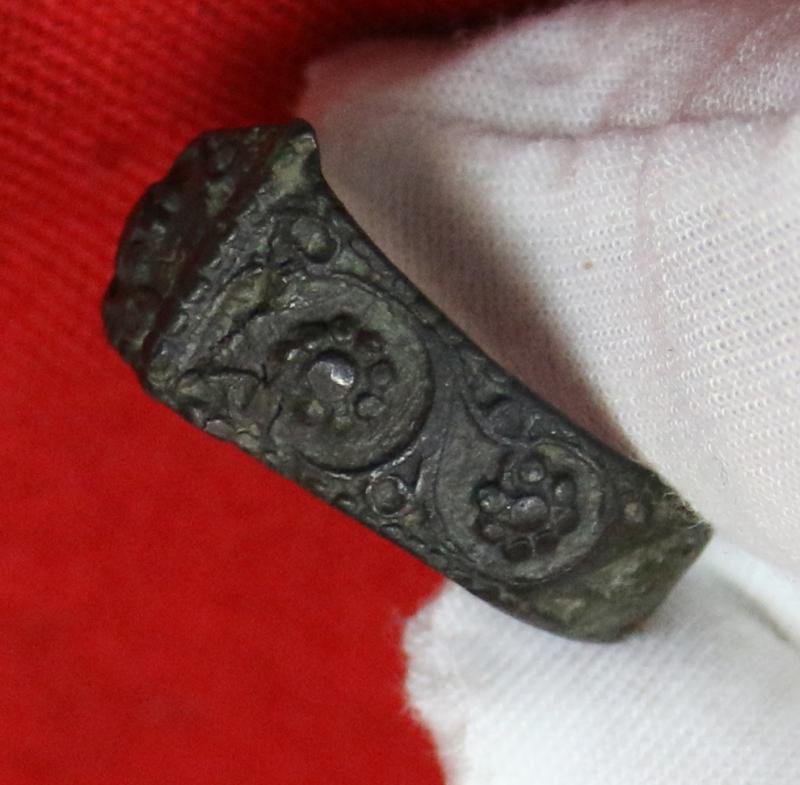
Superb 'War Of The Roses' Period, 15th Century, Rose Head Archers Ring. 'Draw Archers, Draw Your Arrows to the Head!' Richard IIIrd, By Shakespeare, Before the Battle of Bosworth. Embellished with Numerous English Royal Rose Heads Across The Entire Ring
Sold
£895.00
—
Description
What a fabulous piece of history!.Bronze thumb ring with numerous relief cast royal rose head designs upon the whole surface. Overall in very nice condition, with very fine natural age patina, and, remarkably, a good wearable size.Archers used thumb rings during the Wars of the Roses (15th Century England), primarily for the powerful English longbow, protecting the thumb from the bowstring. Many of the bowmen wore iron sallet helmets, and identifying noble or royal crests, such as boars heads for King Richard, plus, royal rose heads symbols, that were stitched upon their tunics or tabards, either white for Yorkists, or red for Lancastrians.Richard III was one of the kings who recognised the value of the archer; Shakespeare makes him say, just prior to the Battle of Bosworth: 'Draw archers, draw your arrows to the head!' There are also records telling that Richard sent a body of 1,000 archers to France to aid the Duke of Brittany. Henry VII also provided anti-crossbow legislation and sent large levies of English archers to fight for the Duke of Brittany. During this entire period English longbowmen served in many parts of the then-known world.A stunning condition cast bronze archer's ring embellished with the roses of the royal houses of either York, or Lancaster. The rose was the symbol of divinity and royalty. With stylized multiple 15th century rose symbols in bronze, across the entire shank, it is near impossible to decide with royal side it was from.However, this ring may well be more likely the Yorkist rose, for a Yorkist archer, due to another near identical example we had thirty years ago. It was special and identifiable enough to be easily memorable, and near identical to this one, that was recovered just around Anbion Hill around 200 years ago.Ambion Hill is a significant historical landmark in Leicestershire, England, famous as the former site of Richard III's camp before the pivotal Battle of Bosworth Field in 1485, though the battle's core is now known to be nearby. It's home to the Bosworth Battlefield Heritage Centre and features memorials, including a sundial marking a traditional water source for Richard III, and marks the location of the deserted medieval village of Anebein.The name of the Wars of the Roses comes from emblems used by the warring parties. It is often attributed to Walter Scott who referred to 'the wars of the White and Red Roses' in a novel written in 1829 (Anne of Geierstein). However, the idea of a conflict involving roses started in the fifteenth century. One ballad called Edward IV the 'the Rose of Rouen' and, shortly after he became king, a painting was made in which members of the royal family, fighting each other, grew out of stylised red, white and gold roses.In the Middle Ages, roses were considered the pre-eminent flower of the plant kingdom and so they were common symbols of divinity and royalty. The white rose was one of the emblems often used by the House of York. The red rose was perhaps used by Lady Margaret Beaufort, mother of Henry VII, before 1485 and maybe by earlier members of the House of Lancaster, although firm evience is lacking.The Tudor RoseAfter marrying Elizabeth of York, Henry VII combined the two roses to form the Tudor Rose to symbolise the peace which he claimed his reign had brought to England. Public pageants and poetry publicised this message and Shakespeare made it famous in his 'history plays'. The plays of his second tetrarchy are full of metaphors of England as a garden that is not being properly looked after during the conflict between kings. Richard II is called a 'fair rose', Henry IV 'this thorn, this canker'. The origin of Walter Scott's title is probably the scene in Henry VI Pt 1 in which the Dukes of York and Somerset invite their supporters to pick white or red roses to declare their allegiances. The theme is picked up again in Henry VI Pts 2 and 3 and Henry Tudor's final speech in Richard III promises:We will unite the white rose and the red./ Smile heaven upon this fair conjunction,/ That long have frown'd upon their enmity!A Latin poem, written down in 1486 is perhaps the earliest evidence of the ideas that led to the Tudor rose. It refers to Richard III's emblem of the white boar and ends with the words,the tusks of the Boar were blunted and the red rose, the avenger of the white, shines up on us.Though traditional English archers often used three fingers (Mediterranean draw) or finger tabs, while thumb rings were more common in Eastern archery (Turkish/Mughal styles), but finds like a bronze thumb ring from Agincourt (1415) prove their use by English archers, especially in large-scale battles, offering a smooth release for powerful bows, despite debate on their universal use in England.The main purpose was to shield the thumb from the abrasion and injury caused by the bowstring (often waxed hemp or linen) when releasing the arrow, especially with heavy longbows.A well-made ring, particularly those with a smooth, rounded edge, allowed the string to 'slip' off the thumb cleanly, enabling a faster, more consistent release than fingers alone, notes this YouTube video.In the Wars of the Roses English archers famously used the longbowWhile common in Asian and Middle Eastern archery (Mughal, Turkish), their presence in Europe shows cultural exchange or independent adoption for powerful bows, says the Victoria and Albert Museum, which houses both such Mughal rings and British.The rings could be made from various materials, including bronze, bone, horn, or even stone (like the diorite ring found in Meroë), depending on origin and period, explains National Museums Liverpool.In summary, thumb rings were a tool for medieval archers, including those fighting in the Wars of the Roses, to enhance comfort and performance with powerful bows
Dealer Info
Dealer Info
-
 Brighton, East Sussex · United Kingdom