
1 / 22

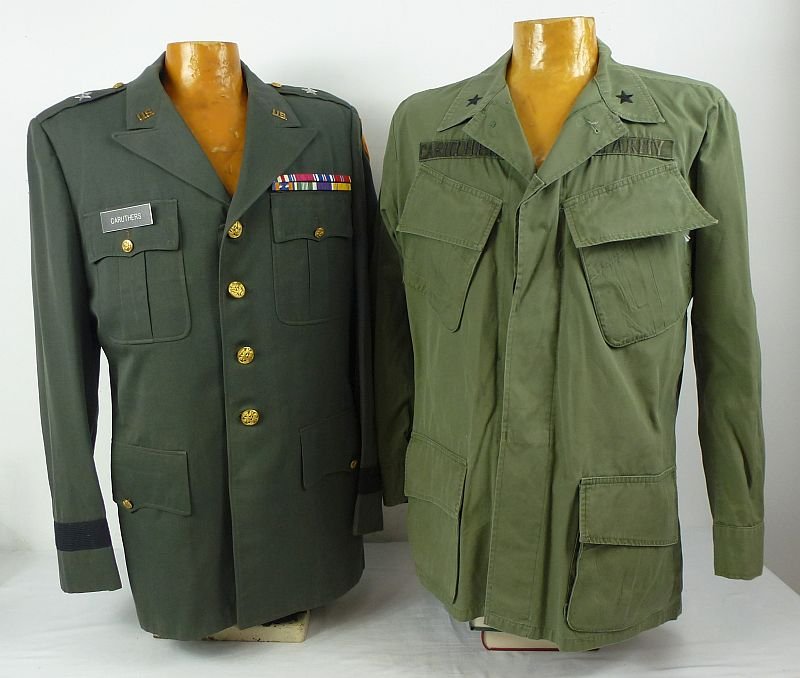
The Uniform and Jungle Jacket of U.S. Army Brigadier General Lawrence Caruthers
Available
$595.00
—
Description
The group is comprised of General Caruthers' Model 1954 Class 'A' uniform, with both the jacket and trousers, as well as General Caruthers' jungle jacket. The left shoulder bears the patch of the Army Field Artillery School. The left shoulder has threads where a sleeve patch was removed, apparently the insignia of the 1st Infantry Division, in which Caruthers served as artillery commander in Vietnam. The Class A uniform is named to General Caruthers and it shows relatively light wear. The jungle jacket similarly exhibits wear and use, but it is in very good used condition.Lawrence H. Caruthers Jr. of Los Angeles California was the son of an artillery officer. He was commissioned a Second Lieutenant of field artillery after graduating from theU.S.M.A. in 1942. He served with the 4th Armored Division until June 1943 when he was transferred to the 16th Armored Division, with that unit until January 1945 as a batterycommander. After a brief post-war stint in Europe, he returned to the United States in 1947. He began his first of three tours at the Pentagon in 1951, leaving there in 1953 and in 1954 joiningthe 1st Cavalry Division in Japan. He commanded the 99th Artillery Battalion, 1st Cavalry Division until July 1956. Then Lieutenant Colonel Carruthers became the ExecutiveOfficer of the 1st Cavalry Division Artillery, later helped in converting it to the first missile command in the Far East. In 1966 Colonel Carruthers arrived in Vietnam as commander of Division Artillery, 1st U.S. Infantry. When the Tet Offensive began in 1968, Brigadier General Carruthers moved to MACV forward headquarters, where he assumed command of the Corps Artillery inMarch of that year. In September of 1968 he was transferred to Fort Sill, Oklahoma as the Assistant Commandant of the U.S. Army Artillery and Missile School. His decorations include: the Silver Star; the Legion of Merit with one Oak Leaf Cluster; Distinguished Flying Cross with one Oak Leaf Cluster; the Bronze Star medal with 'V' device and three Oak Leaf Clusters; and the Air Medal with 22 Oak Leaf Clusters; the Army Commendation Medal with two Oak Leaf Clusters; the Purple Heart; and the Vietnamese Cross of Gallantry with Silver Star.During Vietnam, the Army moved to centralize the OCS system at Fort Benning in 1968, but General Caruthers fought to keep the Artillery OCS at Fort Sill. Nine OCS programsoperated during the Vietnam War and by the end of 1968 only Infantry, Artillery, Engineer and WAC OCS remained. Engineer closed early in 1971 and Artillery operateduntil July 1973. The WAC program continued to produce a limited number of graduates until it was integrated with the Fort Benning program in 1976.The Brigadier General Lawrence H. Caruthers OCS Leadership Award was established in his honor.
Dealer Info
Dealer Info
-
 Shoemakersville, Pennsylvania · United States