
1 / 7

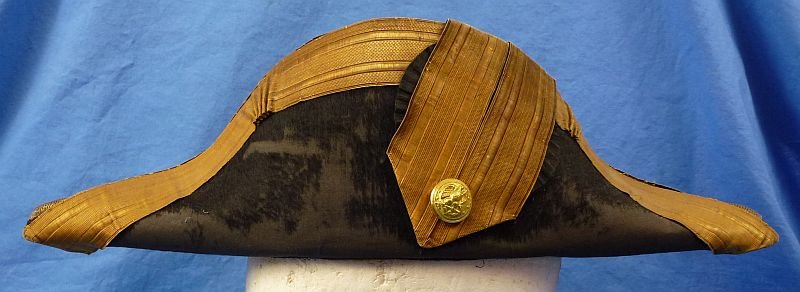
Named U.S. Navy Admiral's Fore and Aft Hat by N.S. Meyer
Available
$375.00
—
Description
The hat shows significant wear to the exterior velvet surfaces. The gold bullion tape and knots are toned with age. The interior of the hat is maker marked by the N.S. Meyer firm and it bears the written name of 'Sexton'. This was presumably Walter R. Sexton who, after graduation from the Naval Academy, served in the Spanish–American War and the Philippine–American War. He commanded the destroyerBainbridgefrom August 1904 to March 1905. In 1906, Sexton was given command of the cruiserVesuvius. In July 1909, he was promoted to lieutenant commander.In 1913, he served as flag secretary on the staff of Rear Admiral Charles J. Badger aboard the battleshipWyoming. In August 1916, he was promoted to commander. During World War I, Sexton received a temporary promotion to captain and served on the staff of the commander-in-chief of U.S. naval forces in European waters, earning the Navy Cross.After the war in October 1919, Sexton replaced Rear Admiral Harry S. Knapp as the U.S. naval attaché in London. He was then given command of the armored cruiserFrederickfrom November 1920 to February 1922. In June 1921, his promotion to captain was made permanent. Sexton served as the commanding officer of the battleshipUtahfrom April to October 1925.Sexton was given command of Destroyers, Scouting Fleet in 1929 and promoted to rear admiral in March 1930. In 1931, he became an Assistant Chief of Naval Operations. In 1933, Sexton was named commander of Battleships, Battle Force and given the temporary rank of vice admiral. From 1934 to 1937, he reverted to his permanent rank of rear admiral and served on the Navy General Board. From 1937 to 1939, Sexton was commander of Destroyers, Battle Force.From 1939 to 1942, Sexton served as chairman of the Navy General Board. He retired after reaching the age of sixty-four in September 1940, he was then originally slated to be replaced by Rear Admiral John W. Greenslade but was then personally asked to stay on by President Franklin D. Roosevelt.Unlike many senior naval officers with whom he served, Sexton was not advanced to vice admiral on the retired list because he had not served a full calendar year at that rank. In August 1942, he was replaced as chairman by Rear Admiral Arthur J. Hepburn but continued to serve as a member of the General Board.
Dealer Info
Dealer Info
-
 Shoemakersville, Pennsylvania · United States