
1 / 8

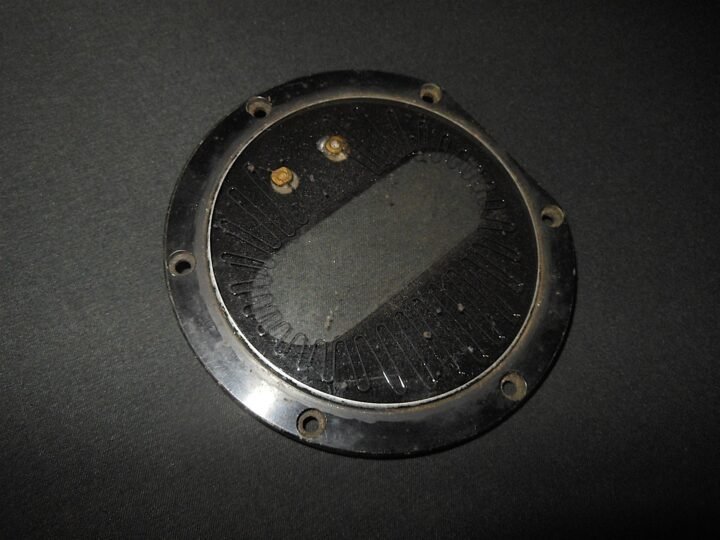
WW2 German Luftwaffe Aircraft – Lotfe 7D Heizscheibe – HEATED BOMBSIGHT GLASS
Available
$299.99
—
Description
You are bidding on and EXTRAORDINARILY RARE example of a WW2 German Luftwaffe Lotfe 7D Gyroscopic Bomb Sight Heizscheibe (Heated Glass). This component forms the lower optical window of the Lotfe 7 / 7D bombsight assembly and was designed to remain clear during high-altitude operations.This sight was specifically used in the later stages of the war, specifically on the Ar234, Fw200, and Ju88!The Lotfe 7 series bombsights were standard Luftwaffe precision bombing instruments used throughout the war on medium and heavy bombers. Because the lower optical housing protruded beneath the aircraft fuselage into freezing airflow, icing and fogging posed a serious problem. To solve this, the Luftwaffe incorporated an electrically heated glass element into the sight's lower optical path, ensuring consistent clarity and accurate aiming under operational conditions.The Carl Zeiss Lotfernrohr 7 (Lot meant 'Vertical' and Fernrohr meant 'Telescope'), or Lotfe 7, was the primary series of bombsights used in most Luftwaffe level bombers, similar to the United States' Norden bombsight, but much simpler to operate and maintain. Several models were produced and eventually completely replaced the simpler Lotfernrohr 3 and BZG 2 bombsights. The Lotfe 7C, appearing in January 1941, was the first one to have gyroscopic stabilization.The Norden consisted of two primary parts, the optical system, and a large stabilization platform. Both were complex and had to be separately maintained to keep them operational.In the Lotfe 7, a similar set of gyroscopes to that of the Norden, provided a stabilized platform for the bombardier to sight through, although the more complex interaction between the bombsight and autopilot of the Norden was not used. The Lotfe 7 was dramatically simpler, consisting of a single metal box containing the vast majority of the mechanism, with a tube (Rohr) extending out the bottom with a mirror that reflected the image of the target into a small telescope in the box. The mechanisms within combined the functions of the Norden's stabilizer and optics, moving the mirror to stabilize the image as well as tracking the target. The controls were likewise much simpler than the Nordens', consistingase was normally automatic in order to reduce timing errors.primarily of three large knurled knobs to adjust aim Operation was fairly similar to the Norden. The bombardier would first locate the target in the bombsight and continue to adjust the dials until it remained motionless in the eyepiece. This allowed the bombsight to calculate the wind speed from the cancelled out drift rate, which in turn allowed to make an accurate calculation of groundspeed. Unlike the Norden, the Lotfe 7 could view targets directly in front of the aircraft, so the bombardier could use the real target for adjustments, rather than having to 'tune' the instruments on a test target located closer to the aircraft. The bombsight could be used against targets 90° to 40° in front of the aircraft, and up to 20° on either side. On final approach, the autopilot was engaged, while the bombsight adjusted the flight path in response to last-minute changes by the bombardier.The Lotfe 7 was normally installed near the nose of the aircraft with the mirror tube projecting through the fuselage to the outside of the aircraft. In most installations, like those in the Junkers Ju 88 or Heinkel He 111, the tube ended in a fairing under the fuselage with a protruding flat window in front. In other cases, like the Arado Ar 234 or the prototype bomber conversions of the Messerschmitt Me 262, the tube was open to the air, mounted so the mirror window was almost flush with the fuselage line. In the case of the single-seat Ar 234, the bombsight was difficult to access, so the autopilot was engaged first, allowing the pilot to remove the control yoke and access the bombsight.Made of glass with electrical heating elements, this item is in EXCELLENT used condition! Found at a repair and parts facility after the war, the glass retains its circular form with the visible embedded heating element still intact! Designed for electrical anti-icing, the. Condition is VERY NICE, showing some light wear, and handling marks consistent with service use. I have shown its location in the last images. A scarce and desirable original Lotfe bombsight component, seldom encountered as a loose, identifiable part. PERFECT for any collection or display!*** NOTE ***As I have a few of these in stock, the one you receive may look slightly different than the one depicted in the listing photos.
Dealer Info
Dealer Info
-
 Thousand Oaks, CA · United States