1 / 4

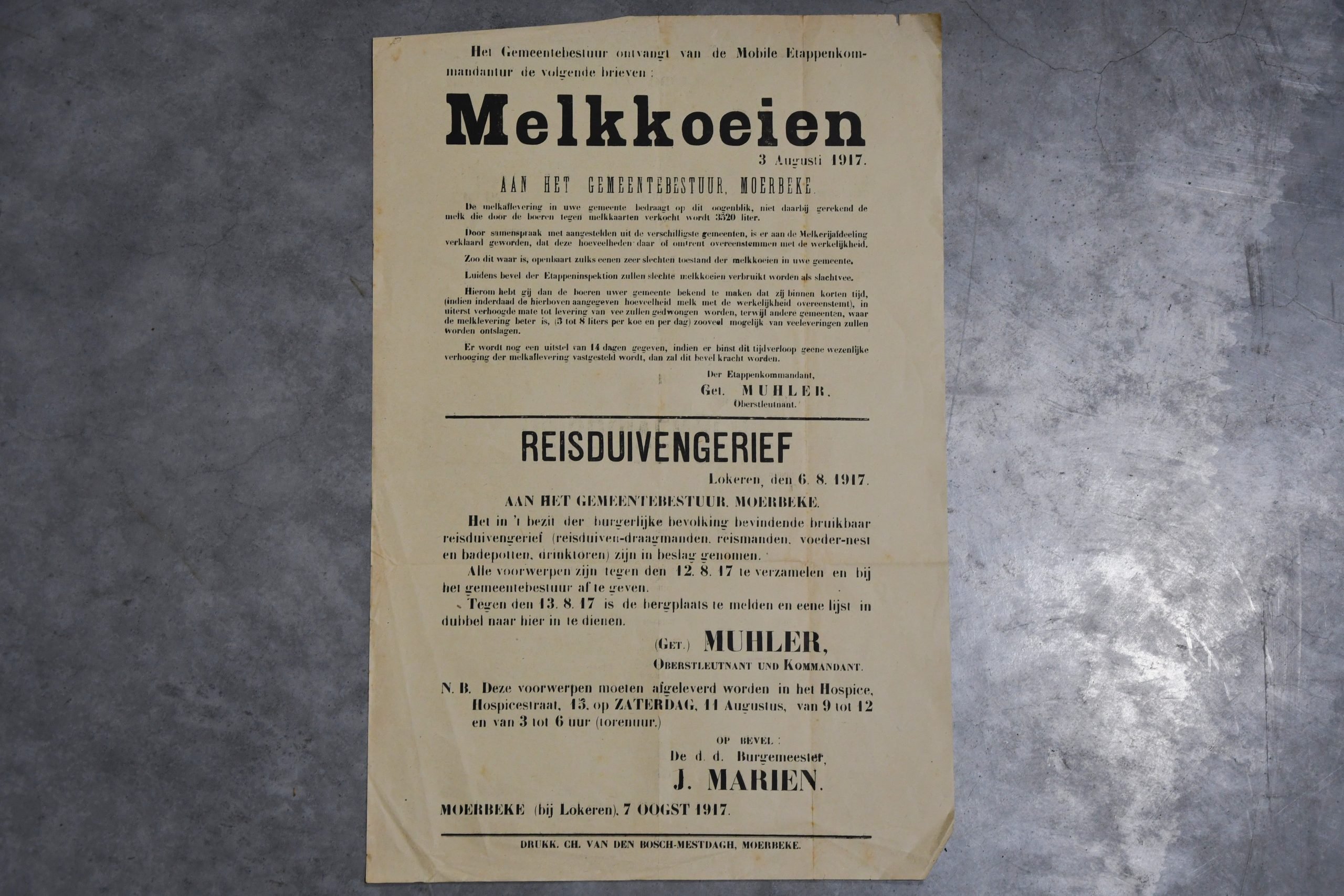
Original WWI German Occupation Poster 'Melkkoeien / Reisduivengerief' – Moerbeke / Lokeren – 1917 – approx. 55 × 36 cm
Sold
€50.00
—
Description
An original First World War Belgian occupation poster combining two official notices titled 'Melkkoeien' (Dairy Cows) and 'Reisduivengerief' (Carrier Pigeon Equipment), issued during the German occupation of Belgium in 1917. The document reflects the strict control and requisitioning of agricultural and communication resources imposed by the German military administration.The upper notice, dated 3 August 1917, concerns milk production and dairy cows within the municipality. It reports that the milk delivery levels in the community were insufficient compared to the number of cows registered. Farmers were warned that dairy cows should not be slaughtered as livestock for meat and that milk production had to be increased. If the required milk supply was not achieved, further measures would be enforced. The notice is issued by order of Oberleutnant Muhler, representing the German Etappenkommandantur, the military administrative authority responsible for occupied territories.The second notice, titled 'Reisduivengerief', dated 6 August 1917, concerns the confiscation of carrier pigeon equipment belonging to civilians. Items such as pigeon baskets, feeding equipment and related materials were ordered to be collected and handed over to the municipal authorities. Carrier pigeons were considered strategically important during wartime for communication purposes, and controlling such equipment was therefore a matter of military security.The poster is dated 7 August 1917 and issued in Moerbeke near Lokeren, signed by order of the acting mayor J. Marien. At the bottom the local printer Ch. Van den Bosch-Mestdagh, Moerbeke is credited.Measuring approximately 55 × 36 cm, the poster represents a typical municipal announcement intended for public display during the First World War. It shows expected signs of age such as fold lines and light wear consistent with a paper notice from this period, but remains in good overall condition and clearly readable.A very interesting historical document illustrating the control of food production and communication resources in occupied Belgium during WWI, making it a desirable item for collectors of First World War memorabilia, occupation history, or early 20th century municipal posters.
Dealer Info
Dealer Info
-
 Zulte, Oost-Vlaanderen · Belgium