
1 / 4

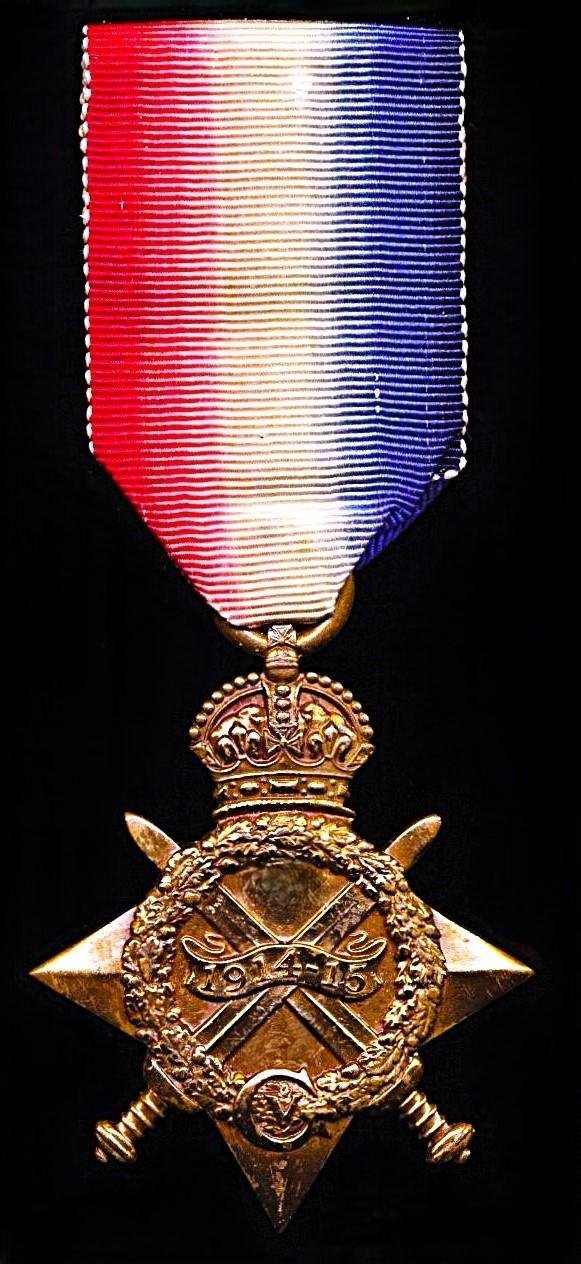
1914-15 Star (L-3499 Pte. J. C. Yates. 21st. Lrs.)
Available
£90.00
—
Description
John Cecil Yates served with the 21st Lancers in Asia (India) from 5 September 1915. The Journal of the 21st Lancers records him in September 1918 as serving with 'A' Squadron, Signal Depot, Poona. He was also a qualified 'Dispatch Rider' (National Register 1939, refers)Important: Recipient confirmed present at the 21st Lancers Victoria Cross action at Shabkadar, North West Frontier of British India on 5 September 1915 (Royal Tank Corps Enlistment Records held at The National Archives refer)The 21st Lancers did not see service on the Western Front during the First World War, being the only regular cavalry regiment of the British Army to spend the duration of the war in India. The regiment did however see action on the North-West Frontier during 1915–16, with one trooper, Charles Hull, receiving the Victoria CrossMedals verification: Private John Cecil Yates, 21st Lancers, is confirmed entitled to the 1914-15 Star and companion Great War medals cited below:- 1914-15 Star: WO 329/2518 (entered theatre of war 'Asia' - for North West Frontier of British India - 5 September 1915)- British War Medal. Silver issue: WO 329/19- Interallied Victory Medal: WO 329/19John Cecil Yates, son of Henry Yates (a Builder & Commercial Traveller) and Louisa Yates (nee Blockley) was a native of Peterborough, Northamptonshire, England, where he was born, 3 July 1886. John came from a very large family. At the time of the compilation of the National Census for England & Wales in 1891, John is recorded living at home with his parents and no less than 11 x siblings, comprising, 5 x sisters and 6 x brothers, who all lived at the family residence located at, Evington, Leicestershire, England. By the time of the 1901 National Census for England & Wales, John was recorded employed as an 'Office Boy', living with his parents and siblings at the family residence now located at, 13 Shelbourne Street, Leicester, England. John Yates was 24 years & 11 months of age, and prior employed as a 'Shop Assistant' when he enlisted in the British Army at Loughborough, on 9 June 1911. On joining-up John was posted to the 21st Lancers. His subsequent record of overseas service was:- Egypt: 19/03/1912 - 30/09/1912- India: 01/10/1912 - 09/11/1919John embarked for the United Kingdom on, 10 November 1919, and disembarked in the United Kingdom on 7 December 1919. He took his discharge from the British Army at Canterbury, England, 8 June 1923. At discharge he held the rank of Corporal. His address given at discharge was, 47 Cobden Street, Loughborough, Leicestershire, England.By the time of the compilation of the National Register of England & Wales in 1939, John is recorded employed as a Hosiery Circular Knitter, and living with his wife Maud Yates (nee Waling) and their daughter Muriel M. Yates at their residence located at, 55 Shelthorpe Road, Loughborough, Leicestershire. Curiously under the remarks column there is an entry that shows that John was sometime a 'Dispatch Rider' holding rank of Corporal on the North West Frontier of India 1916-19. John Cecil Yates is recorded to have died at Loughborough, sometime during the fourth quarter of 1965Note: Only 2 x Squadrons of the 21st Lancers were deployed and qualified for the 1914-15 Star, for their action at Shabkadar, near Hafiz Khor (Tribal territory North West Frontier of British India) on, 5 September 1915The below following account of the battle, whereat Private Hull of the 21st Lancers performed his deeds that won for him the Victoria Cross, was published in the Greymouth Evening Star issue of, 7 December 1915 (courtesy of National Library of New Zealand 'Papers Past'https://paperspast.natlib.govt.nz/newspapers/GEST19151207.2.46 :Quote,LANCERS' SPLENDID CHARGEDESPERATE FIGHT WITH 10,000 TRIBESMEN.MOHMANDS ROUTED ON INDIAN FRONTIER.PESHAWAR, September 9. Thrilling stories of the fighting last week against the rebellious Mohmands on the North-West Frontier are told here by men who took part in the expedition.The 21st (Empress of India's) Lancers were engaged, and two squadrons left Risalpur on August 28 in sweltering heat, and marched to Shabkadr, sixteen miles north of Peshawar, to take part, in a concentration of troops sent up to quell the Mohmands (who last rose in 1897). A number of men returned with sunstroke before they reached Shabkadr. In the early morning of September 5 the Mohmands, estimated at 10,000, came down from the hills by the Khar Pass and advanced right into the open, nearly down to Shabkadr village; they were engaged by our howitzer and 11.F.A. batteries. At' nine o'clock, our left being threatened, the two squadrons of 21st Lancers, one squadron 14th Lancers, and one section 'M' battery 11.H.A. were moved out. These moved out round Shabkadr village and occupied some foothills to the north. Under a very heavy fire this position became untenable, and they retired to the south a short distance immediately afterwards delivering a charge on a large force of the enemy. Wheeling, the two squadrons charged again, their objective being a dense mass of Mohmands in the lied of the Minchi-Abazain canal. This canal is practicably unjumpable, one or two of the leaders (Colonel J. B. Scriven, commanding, and Captain Anderson) jumping it, but the remainder had to drop in and scramble out the other side. Here the men did great execution with the lance, and all got across. When they emerged from the canal the two squadrons came up under a very heavy fire again at fairly close range from the left. Colonel Scriven gave the order to left wheel and charge for the third time, and it was then that most of the casualties occurred. Lieutenant N. R. Thompson was unhorsed after killing three of the enemy. Captain P. H. A. Anderson disappeared during the charge, and it is the opinion that after being wounded his horse bolted into the enemy. His body was found next day.Colonel Striven had his horse shot under him, and was on the ground still unhurt with a corporal whose horse had also been shot. The corporal grabbed a spare horse, and both he and the colonel mounted it, and were getting away when the colonel, was shot through the head and killed. The corporal remained with the colonel's body, keeping the Mohmands off by firing his rifle. This N.C.O. was eventually picked up by the squadrons when they rallied and returned to recover the dead and wounded. A great number of the enemy were accounted for in this charge and they retreated from the ground. In all three officers were killed, and three wounded, four N.C.O.'s and. men were killed, and seventeen wounded.During the last charge a sergeant was unhorsed, and after killing two natives, was grappling with a huge fellow on the ground, their hands at each other's throats, when Saddler-Sergeant. Simpson came up and emptied his revolver into the native, and at the same time was terribly wounded himself, but undoubtedly saved his chum's life. The adjutant (Captain Learoyd) had his horse shot, and was only fifty yards from the enemy when he was rescued by a shoeing smith and taken, to safety. The action of the two squadrons is spoken of in the highest terms, and their charges saved the day. The Mohmands left the Indian cavalry and concentrated all their attention on the British cavalry, this from, fanatical reasons., It is worthy of note that only two days separated the anniversary of this regiment's charge at Omdurman, in 1898, from this new achievement.Unquote.A scarce seen Great War campaign star for a soldier who was present on the North West Frontier of India during the regimental Victoria Cross action of the 21st Lancers - and is confirmed to have served as a 'Dispatch Rider'Condition: Traces of lacquer VF
Dealer Info
Dealer Info
-
 Aberdeen, Aberdeen City · United Kingdom