
1 / 18
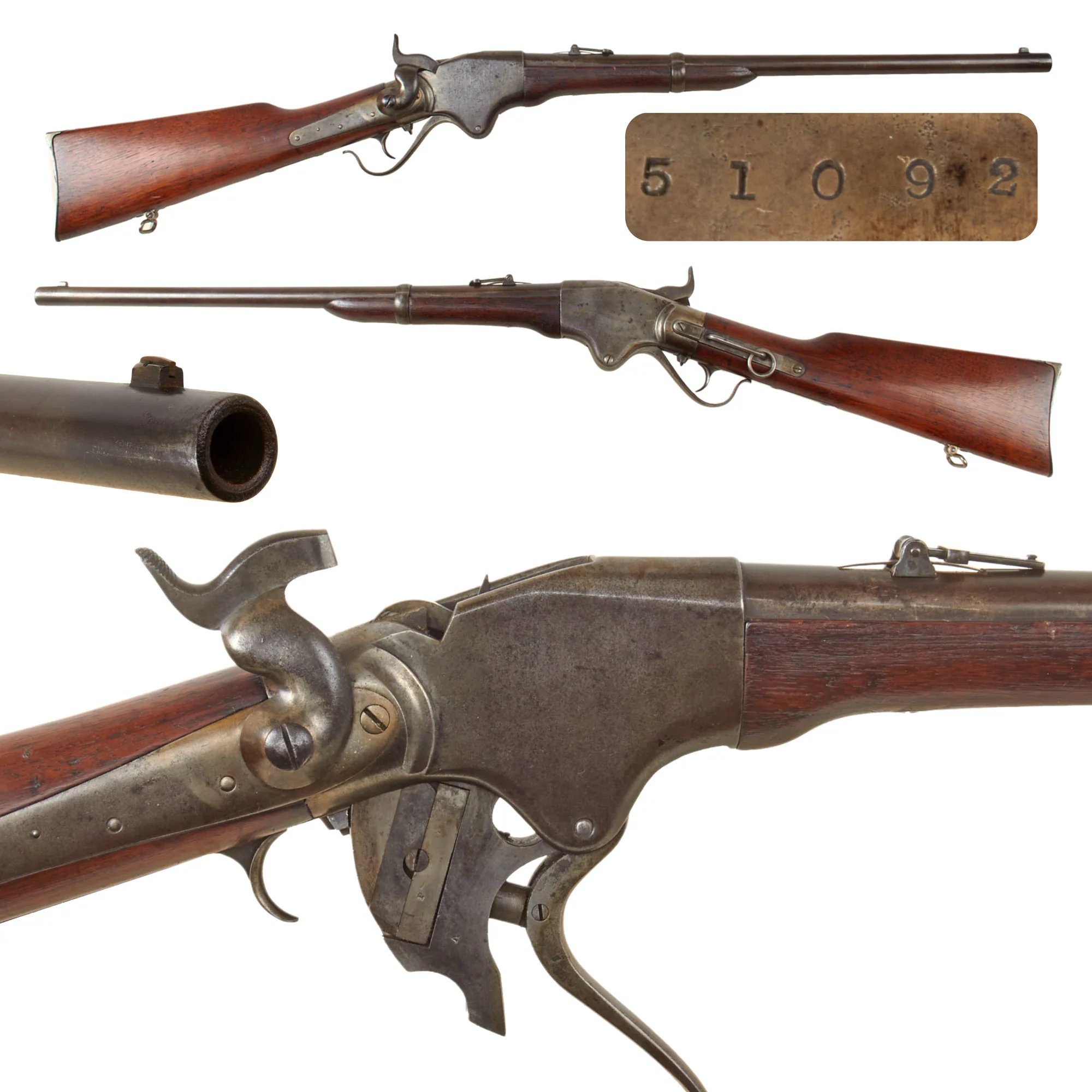
Original U.S. Civil War Model 1860 Spencer Carbine Converted to .50 Rimfire For Indian Wars with Stabler Cutoff - Serial Number 51092
Available
$2495.00
—
Description
Item DescriptionOriginal Item: Only One Available. This is a genuine U.S. Civil War era Spencer Repeating Carbine. All parts are completely correct, and it looks to have seen a good amount of service during the war, as well as afterwards out on the frontier during the 'Indian Wars'. This has given it a fantastic patina and 'been there' look, which looks great in any collection. The Carbine is marked with Serial number51092, on the receiver tang and under the barrel, indicating mid 1864 manufacture. It also is marked with assembly number47on the bottom of the barrel, which is found on other components of the rifle.From Spencer's initial order for 7,500 Carbines starting at serial number 11,001, 7,000 were supplied by December 1863 and the balance in early 1864. We checked the Springfield Research Service records, and this serial number does not appear. We do however see that serial numbers 54151, 542576, 54354, and many others in that range were sent to Company A of the 3rd Kentucky Volunteer Cavalry, so it could have possibly been part of that shipment. Serial numbers in the range were being delivered inmid- late 1864.The carbine comes complete with its original 7-Shot tube magazine stored in the butt, this was the gun that advertised, 'Load on Sunday and Shoot all week'. Maker's markings and patent information are are now just ghosts on top of the receiver, but with a magnifier we were able to see that it is definitely a Spencer made carbine, not one from Burnside:-S[PENCER REPEATING-]R[IFLE CO. BOSTONMAS]S.[PAT'D MARCH 6 1860]Extensively used at Gettysburg, this really is a Civil War Classic!After the Civil War, many Spencer Carbines and Rifles altered and modified at US armories and many remained in service through the early 1870's for use during the Indian Wars. The primary alterations were the addition of the Stabler 'Cut-Off', and lining the barrels to accommodate the new US military standard metallic cartridge, the .50 Government Rim Fire (aka 56-50 Spencer). This allowed the U.S. to standardize the rimfire ammunition they were issuing at the time. As the Spencer design originally utilized a .52' caliber barrel, which was too large for this, all were sleeved to the new, smaller, .50 caliber, which was rifled with 3 wide grooves instead of the Civil War era 6 narrow grooves. Only about 11,000 of the 50,000 Civil War purchased Spencer carbines were altered between 1867 and 1874, so they are not very commonly encountered.This example is definitely one of those that was converted and reissued for Indian Wars service. It still retains the 22 inch barrel of a Model 1860, however the bore measures out to just over .50', and it has wide three groove rifling. Close examination of the muzzle shows that the barrel was drilled out and a sleeve inserted and then brazed in place. These were utilized by numerous Cavalry Regiments during the Indian wars, including the 9th and 10th Cavalry. It also has a Stabler cutoff installed, which is fully functional, though we have no way to know whether it was originally installed, or installed as part of the modifications.The stocks are in very good used condition, showing the lovely red brown color of aged oiled walnut. The fore stock shows some wear, and has a crack along the upper left by the receiver, as well as on the right nose, and right side by the lower receiver. The butt stock is in better shape, showing no major damage, just the usual dents and dings from use. There is a bit of staining around the metal components from past oxidation. The butt stock sling swivel is still present and moves easily.The metalwork overall is in very nice condition, showing a lovely aged patina overall from exposure to the elements during service. There is some light peppering, but no major oxidation or rust damage visible. The saddle ring bar on the left hand side is still present, with an intact saddle ring. The rear sight is present and functional, though the slider is a loose on the ladder.The carbine functions well, and we did not notice any issues with cycling, though we did not try it with any dummy ammo to see if it could still feed. The lock is fully functional, holding at half cock and firing at full, and the stabler cutoff works great as well, with no issues to note. The magazine is in great shape, with an intact spring and follower, and it easily locking into the butt stock to lock it in place. The bore is in very good condition, showing a mostly bright finish with crisp lands and grooves. There is just a bit of wear and some spots of past oxidation and fouling, making this a really great example.Overall a lovely example of an iconic civil war weapon, later modified for use in the Indian Wars, that has passed the test of time with flying colors! Perfect for any collection, and ready to research and display!Specifications-Years of Manufacture: late 1864Caliber: .56-50 Spencer rimfire / .50 Government RimfireAmmunition Type: Rimfire CartridgeBarrel Length: 22 inchesOverall Length: 39 inchesAction: Lever Action with Manual HammerFeed System: 7 Round Tube MagazineHistory and overview of the Spencer repeating rifle and carbine-The Spencer repeating rifle was a manually operated lever-action, repeating rifle fed from a tube magazine with cartridges. It was adopted by the Union Army, especially by the cavalry, during the American Civil War, but did not replace the standard issue muzzle-loading rifled muskets in use at the time. The Spencer carbine was a shorter and lighter version.The design was completed by Christopher Spencer in 1860, and was for a magazine-fed, lever-operated rifle chambered for the 56-56 Spencer rimfire cartridge. Unlike later cartridge designations, the first number referred to the diameter of the case ahead of the rim, while the second number referred to the diameter at the mouth; the actual bullet diameter was .52 inches. Cartridges were loaded with 45 grains (2.9 g) of black powder.To use the Spencer, a lever had to be worked to extract the used shell and feed a new cartridge from the tube. Like the Springfield Model 1873 Trapdoor Rifle, the hammer had to be manually cocked in a separate action. The weapon used rimfire cartridges stored in a seven-round tube magazine, enabling the rounds to be fired one after another. When empty, the tube could be rapidly loaded either by dropping in fresh cartridges or from a device called the Blakeslee Cartridge Box, which contained up to thirteen (also six and ten) tubes with seven cartridges each, which could be emptied into the magazine tube in the buttstock.There were also 56–52, 56–50, and even a few 56–46 versions of the cartridge created, which were necked down versions of the original 56–56. Cartridge length was limited by the action size to about 1.75 inches, and the later calibers used a smaller diameter, lighter bullet and larger powder charge to increase the power and range over the original 56–56 cartridge, which, while about as powerful as the .58 caliber rifled musket of the time, was underpowered by the standards of other early cartridges such as the .50–70 and .45-70.At first, conservatism from the Department of War delayed its introduction to service. However, Christopher Spencer was eventually able to gain an audience with President Abraham Lincoln, who subsequently invited him to a shooting match and demonstration of the weapon. Lincoln was impressed with the weapon, and ordered that it be adopted for production.The Spencer repeating rifle was first adopted by the United States Navy, and subsequently adopted by the United States Army and used during the American Civil War where it was popular. The South occasionally captured some of these weapons and ammunition, but, as they were unable to manufacture the cartridges because of shortages of copper, their ability to take advantage of the weapons was limited. Notable early instances of use included the Battle of Hoover's Gap (where Col. John T. Wilder's 'Lightning Brigade' effectively demonstrated the firepower of repeaters), and the Gettysburg Campaign, where two regiments of the Michigan Brigade (under Brig. Gen. George Armstrong Custer) carried them at the Battle of Hanover and at East Cavalry Field. As the war progressed, Spencers were carried by a number of Union cavalry and mounted infantry regiments and provided the Union army with additional firepower versus their Confederate counterparts. President Lincoln's assassin, John Wilkes Booth was armed with a Spencer carbine at the time he was captured and killed.The Spencer showed itself to be very reliable under combat conditions, with a sustainable rate-of-fire in excess of 20 rounds per minute. Compared to standard muzzle-loaders, with a rate of fire of 2-3 rounds per minute, this represented a significant tactical advantage. However, effective tactics had yet to be developed to take advantage of the higher rate of fire. Similarly, the supply chain was not equipped to carry the extra ammunition. Detractors would also complain that the smoke and haze produced was such that it was hard to see the enemy.In the late 1860s, the Spencer company was sold to the Fogerty Rifle Company and ultimately to Winchester. With almost 200,000 rifles and carbines made, it marked the first adoption of a removable magazine-fed infantry rifle by any country. Many Spencer carbines were later sold as surplus to France where they were used during the Franco-Prussian War in 1870.Despite the fact that the Spencer company went out of business in 1869, ammunition was sold in the United States up to about the 1920s. Later, many rifles and carbines were converted to centerfire, which could fire cartridges made from the centerfire .50–70 brass.NOTE:International orders of antique firearms MUST be shipped using UPS WW Services (courier). USPS Priority Mail international will not accept these. International customers should always consult their country's antique gun laws prior to ordering.Shipping RestrictionsThis product is not available for shipping in US state(s): New JerseyThis product is available for international shipping.Payment OptionsNot eligible for payment with Paypal or AmazonLegal InformationIMA considers all of our antique guns as non-firing, inoperable and/or inert. Title 18, U.S. Code, Section 921(a)(16) defines antique firearms as all guns made prior to 1899. This law exempts antique firearms from any form of gun control or special engineering because they are not legally considered firearms. No FFL, C&R or any license is required to possess, transport, sell or trade Antique guns. All rifles and muskets sold by IMA that were manufactured prior to 1899 are considered Antiques by the US BATF (United States Bureau of Alcohol, Tobacco & Firearms). Therefore, all of IMA's Antique guns may be shipped to all US States and most nations around the world.These antique guns are not sold in 'live' condition, and are not tested for the the ability to feed or load any type of cartridge. They are sold as collector's items or as 'wall hangers' not for use, and we make no guarantees regarding functionality aside from what is stated in the description. Any attempt at restoring an antique gun to be operational is strongly discouraged and is done so at the risk of the customer. By purchasing an antique gun from IMA you thereby release IMA, its employees and corporate officers from any and all liability associated with use of our Antique guns.Pre-1899 Manufacture, no licenses required, allowed to ship to almost any deliverable address across the globe. Please note that for international shipping, these MUST be shipped using UPS WW Services. International customers should always consult their country's antique gun laws prior to ordering.