
1 / 14
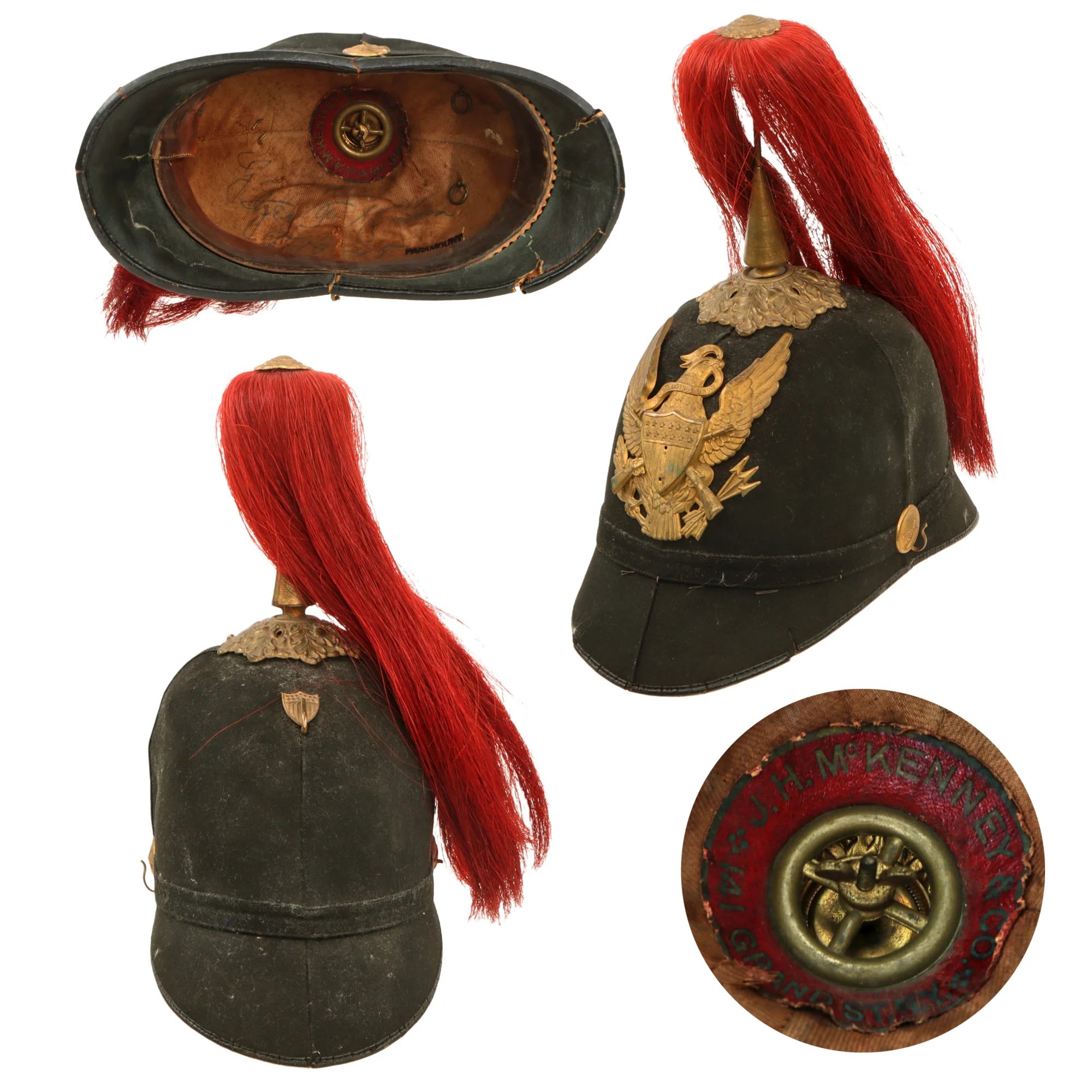
Original U.S. Indian Wars 1881 Model Infantry Regiment Dress Helmet by J.H. McKenney & Co. with Red Plume
Available
$495.00
—
Description
Item DescriptionOriginal Item: One Only Available. Much like our European cousins in the 1880s, the U.S. Army started to adopt spiked pith helmets, often in white, with all brass mounts and occasionally plumes. These saw active service in the Spanish American War of 1898 especially in the tropical climate in Cuba. While often referred to as 'pith helmets' in the broad sense, it was made from cork, like many European variants, such as the Wolseley pattern used by the British.This example is maker-marked to J.H. McKenney & Co., which fell into financial ruin in the late 1880s, so that context dates this example to the mid-1880s. This example shows very heavy damage with some crushing of the helmet itself. This is not the type of helmet that was worn in the field, but instead one intended for use with the 'dress' uniform for ceremonial occasions. This example was made from cork covered with brown fabric, and retains a red plume normally meant for field artillery. There is a makers stamp inside around the spike fixture:J.H. MCKENNEY & CO.141 GRAND ST. N.Y.There is a Federal Army of the United States front plate with crossed rifles behind the shield, and there are two holes in the shield meaning that there was originally a numeral denoting the regiment there. The sides of the helmet have correct crossed rifle infantry bales, but the red plume is likely not original to the helmet as that denotes field artillery. There is some tearing in the material along the front visor, and the sides of the helmet have been pushed in, damaging the cork.The interior also has a faded unit marking, a handwritten name and information, and aPARAMOUNTstamp denoting this saw movie use in the 20th century.Ready for display.The Model 1881 Dress Helmet was worn only for full dress events. The helmet evolved from the earlier Model 1872 helmets worn only by the Cavalry, Light Artillery and Signal Corps. In 1881, the new helmet design was adopted for use by all enlisted troops and for officers of the Infantry, Cavalry and Artillery. (General and Staff officers continued to wear a chapeau de bra as they had for many years…) For enlisted troops, the helmet was made of black felt, while officers could buy a helmet of black cloth over a cork or felt base. Atop the helmet of all mounted troops is a brass plume holder, resting on a brass base having an oak leaf and acorns motif, while the plume holder itself is engraved with an eagle and star. For enlisted men, a thin rod with two circular plates at the top clamps the base of the horsehair plume and rests atop the plume holder, while officers had a similar device to let the plume appear like it was fountain sprung from their heads. The plume's color depended on the branch of service the soldier was in: white for mounted Infantry officers, red for Artillery and yellow for Cavalry.The Arms of the United States forms the large insignia on the helmet's face. Again, depending on the branch of service, one of four different eagle designs formed the insignia. Enlisted troops in branches other than the 'Big Three' wore the general services eagle, while dismounted officers from another corps wore either an Infantry or an Artillery plate. For all Infantry, Artillery and Cavalry personnel, a small white metal numeral of the assigned regiment is affixed by small wires to the shield of the eagle plate. Other corps had a small device to signify their assigned branch. For all mounted troops, the helmet cord is hung on the helmet from two devices. For enlisted troops, the cord's color matched that of their branch, while all officers wore a two-piece cord of braided, gilt thread. The cord's braided bands drape over the front and back of the helmet. The remainder then falls to the left shoulder and gets secured by a slide, goes around both sides of the head and gets secured by another slide, then around both sides of the right arm and gets secured by a third slide, then the two lozenge ends are secured to a button on the frockcoat and simply dangle.For all officers, a brass chain chinstrap hangs from two corps-faced buttons with hooks on them. All dismounted officers of Infantry and Heavy Artillery wore the same helmet and base plate, but with a plain brass spike on top. Those officers also wore the brass chain chinstrap. It was draped across the helmet's face, from a shield hook on the helmet's upper right back to the left helmet button, when not being used. Enlisted troops had a simple leather band for a chin strap, with two corps-faced buttons on the sides.Shipping RestrictionsThis product is available for international shipping.Payment OptionsEligible for all payments - Visa, Mastercard, Discover, AMEX, Paypal & Sezzle