1 / 14
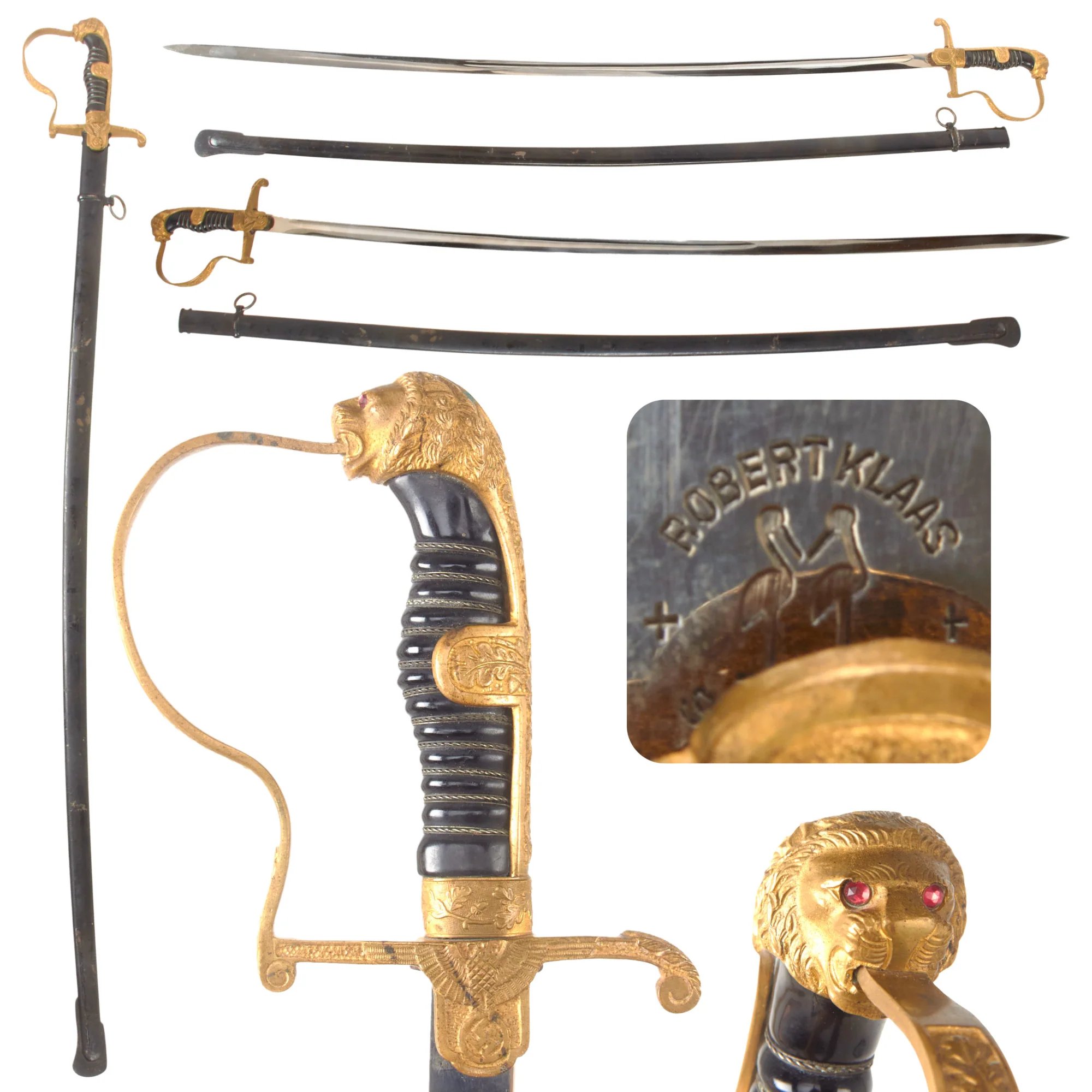
Original German WWII Army Heer Officer's Lion Head Sword by Robert Klaas of Solingen with Steel Scabbard
Available
$795.00
—
Description
Item DescriptionOriginal Item: Only One Available. This is a beautiful classic Lionhead German WWII Army Officers sword, made by the well known firm ofRobert Klaas, Feine Solinger Stahlwaren, of Solingen, Germany, complete with its original scabbard. This is the first example of an Army Officer sword we have had from this maker, and it seems to be that they did not make a large number.This piece is a real treasure as the hilt is not constructed from the later war aluminum, but rather is made of solid brass. It really looks great, retaining much of the finely gilded finish, particularly in the recessed areas. The design consists of a finely detailed lion head cat with a high relief embossed backstrap and 'P' guard. The Lion is fitted with lovely blood red faceted 'jewel' eyes, both of which are in fantastic condition. There is nice detail throughout his whiskers, chin, and muzzle. The handwork is beautifully rendered throughout the hilt. The backstrap and side tabs bear the iconic German 'Oak Leaves & Acorns' motif, which is repeated on the outside of the guard and grip ferrule. The cross guard has a lovely Art-Deco style open wingedReichsadlereagle that looks to the viewer's left. The breast area of this eagle, as well as the wings, have been hand-enhanced. The reverse has a small oval plate where a monogram is sometimes added, though this example is blank.The grip is a very nice black celluloid-over-wood base. It is wrapped with a skein of 4 wires that look to be plated steel, the center of which is twisted. The wrapping is still tight on the grip, and the celluloid is still tight to the wood, and is quite shiny, without any chipping, though there is a bit of checking near the pommel. The hilt overall is still tight on the blade, without any wobble on any of the components, and the leather blade buffer is still installed.The nickel plated blade is 34 3/8 inches long, made of high quality spring steel. The plating is in excellent condition, showing just a few spots of scuffing as well as oxidation right next to the cross guard. The edge is still correctly unsharpened, showing just a few tiny dents, and the tip is also fully intact and unbent.This lovely early example was produced by the desirable firm ofRobert Klaas, Feine Solinger Stahlwaren(Fine Solingen Steelware), based in the Ohligs borough of Solingen, Germany, the Legendary 'City of Blades.' It was and still is the blade-making capital of Germany, with a centuries long history of edged weapon manufacture. Their well-known trademark 'Facing Storks' emblem was first registered in 1893, and the rear ricasso of the blade bears the companies address marking:ROBERT KLAAS+ (Kissing Storks) +SOLINGENThe firm was originally founded in 1834 by Peter Daniels Pauls, whose daughter married scissor maker Friedrich Robert Klaas. After his father-in-law passed away, all was left to Klaas and his wife, so he merged his scissor business with the knife business, and registered with Solingen authorities in 1869. The company passed to his sons, and then his son-in-law. It survived WWI, WWII, and still exists today, per J. Anthony Carter's fine workGERMAN SWORD AND KNIFE MAKERS.The scabbard of this example is still mostly straight, without any major dents we can see, however we do see a bit of an overall curve and a 'dog leg' bend near the middle. This does not however interfere with sheathing the blade. It has very good original factory black enamel, which is retained at about 80%! We can see some checking and crazing to the finish, confirming that it has not been repainted, and the reverse shows some 'clouding' of the finish. There is some chipping and missing paint, but no major damage. The scabbard still retains the original hanger ring and flat loop to hook on the belt hanger, which are missing some of the finish.Overall a very good condition high quality sword from a well-known German sword maker, based in Solingen, the 'City of Blades' in Western Germany. Ready to display!Specifications:Overall length: 39 5/8'Blade length: 34 3/8'Blade Style: Single Edged with FullerGuard dimensions: 5' width x 4 1/2' lengthScabbard Length: 35 3/8'The German Army (German: Heer, was the land forces component of the Wehrmacht, the German armed forces, from 1935 to 1945. The Wehrmacht also included the Kriegsmarine (Navy) and the Luftwaffe (Air Force). During World War II, a total of about 15 million soldiers served in the German Army, of whom about seven million became casualties. Separate from the army, the Waffen-SS (Armed SS) was a multi-ethnic and multi-national military force of the Third Reich. Growing from three regiments to over 38 divisions during World War II, it served alongside the army but was never formally part of it.Only 17 months after AH announced publicly the rearmament program, the Army reached its projected goal of 36 divisions. During the autumn of 1937, two more corps were formed. In 1938, four additional corps were formed with the inclusion of the five divisions of the Austrian Army after the Anschluss in March. During the period of its expansion by Adolf AH, the German Army continued to develop concepts pioneered during World War I, combining ground (Heer) and air (Luftwaffe) assets into combined arms teams. Coupled with operational and tactical methods such as encirclements and the 'battle of annihilation', the German military managed quick victories in the two initial years of World War II, prompting the use of the word Blitzkrieg (literally lightning war, meaning lightning-fast war) for the techniques used.The German Army entered the war with a majority of its infantry formations relying on the horse for transportation. The infantry remained foot soldiers throughout the war; artillery also remained primarily horse-drawn. The motorized formations received much attention in the world press in the opening years of the war, and were cited as the main reason for the success of the German invasions of Poland (September 1939), Norway and Denmark (April 1940), Belgium, France and Netherlands (May 1940), Yugoslavia (April 1941) and the early campaigns in the Soviet Union (June 1941). However their motorized and tank formations accounted for only 20% of the Heer's capacity at their peak strength.Shipping RestrictionsThis product is available for international shipping.Shipping not available to: Australia, France, or GermanyPayment OptionsNot eligible for payment with Paypal or AmazonLegal InformationDue to legal restrictions this item cannot be shipped to Australia, France or Germany. This is not a comprehensive list and other countries may be added in the future.