1 / 7
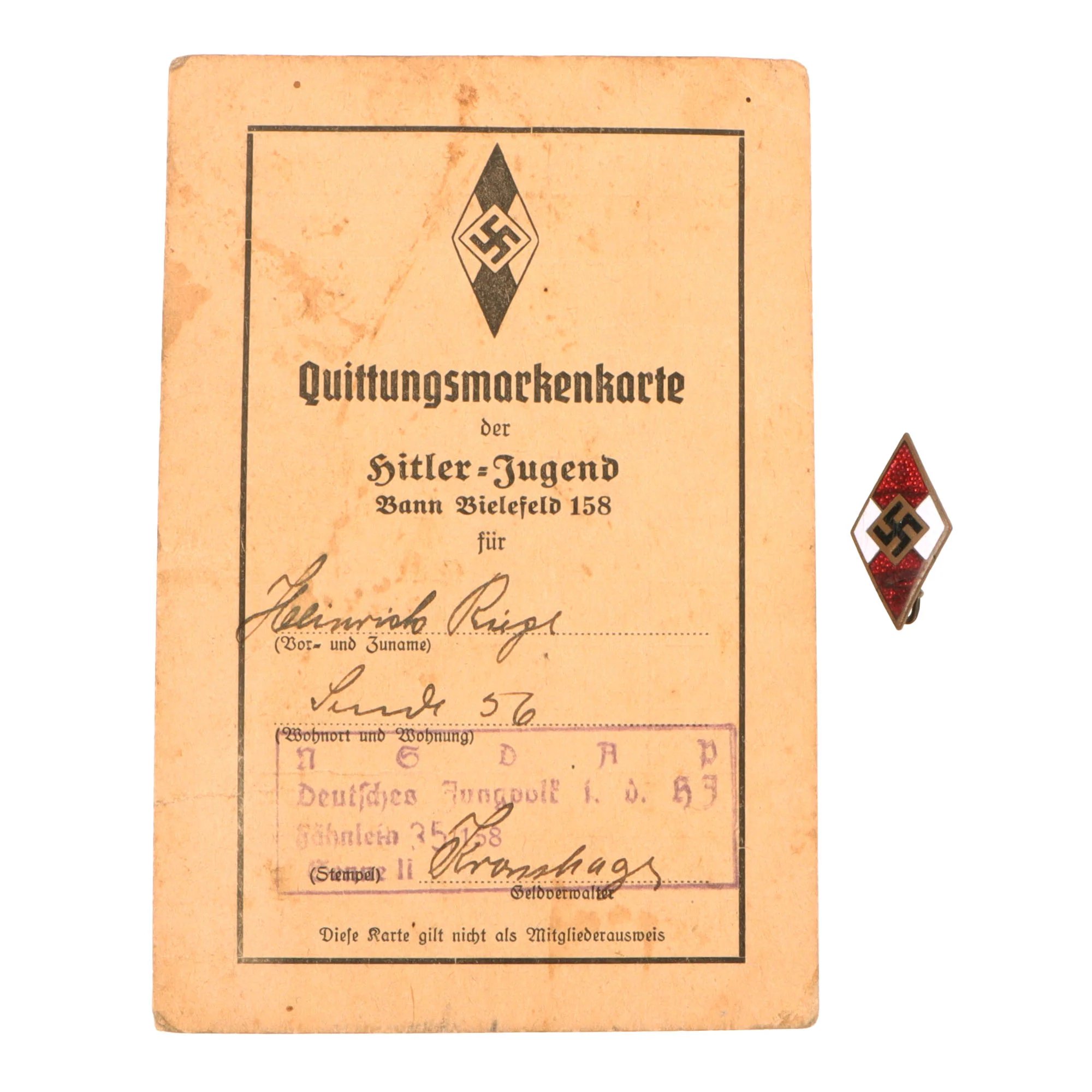
Original German WWII HJ Enamel Cap Badge Insignia by Frank & Reif of Stuttgart with HJ Stamp Card - RZM M1/102
Available
$250.00
—
Description
Item DescriptionOriginal Items: Only One Set Available. This is a very nice German WWII HJMützenabzeichen(HJ Cap Badge), complete with an original named HJQuittungsmarkenkarte(Receipt Stamp Card) fromBann Bielefeld 158. As with all NSDAP organizations, badges and records were kept, and these two items represent the basic elements all members would need. We can see that the owner was in theDeutſches Jungvolk i. d. HJ, so they were a younger member aged 10-14. The card measures 3 1/4' x 4 7/8', and is in very good condition, showing the expected staining from age.The badge in this set is marked RZM M1/102 for manufacture byFrank & Reif of Stuttgart, Germany. It is constructed out of a die stamped nickel alloy base that has been silver washed and contains white, black, and translucent red enamel work. The rhomboid diamond shaped obverse depicts the HJ National Youth Organization emblem, which consists of a black mobile swas (hook cross) above a silvered square diamond which is surrounded by alternating white and red translucent pebbled quadrants, all surrounded by a small silvered border. The full back reverse has a horizontally soldered bent flat wire attachment clasp and is maker markedM1/102on the top and((RZM))on the bottom. The pin measures approximately 25mm tall by a 13mm wide.The plating is well retained on the back, and still partly bright, however the front has lost the plating, and now displays a 'mustard' patina on the borders. The enamel is fully present, however there are cracks present in most of the quadrants, which has allowed the pebbled background behind the red to oxidize a bit.A very nice small HJ set, perfect for research and display!AH believed German youth to be the future of his 3rd Reich. The HJ (AH Jugend or HJ) was formed officially in 1935, and with the exception of NSDAP ideology indoctrination was very similar to the Boy Scouts. Beginning at about the age of ten years, both boys aged 14-18 (AH Jugend) and girls aged 14-18 (Bund Deutscher Mädel) were enlisted in the Party-run organization.Of Note: In late 1934 items manufactured for the NSDAP and other organizations, including membership pins, came under the quality control of the RZM, Reichzeugmeisterei, (National Equipment Quartermaster) and as a result were marked with the RZM logo when appropriate. The registry was was based at the Brown house in Munich and NSDAP party headquarters in Berlin. The RZM ensured that the manufacturers of military items were consistent in design, quality of materials and other characteristics of the items. It also defined standards of design, manufacturing and quality and published an authoritative color chart for textiles. The M1 in the code stands for Metal Badges, with Frank & Reif of Stuttgart being contractor number 102.History of the HJ National Youth Organization:In 1922, the Munich-based NSDAP established its official youth organization called Jugendbund der NSDAP. It was announced on 8 March 1922 in the Völkischer Beobachter, and its inaugural meeting took place on 13 May the same year. Another youth group was established in 1922 as the Jungsturm Adolf 'AH'. Based in Munich, Bavaria, it served to train and recruit future members of the Sturmabteilung (SA), the main paramilitary wing of the NSDAP Party at that time.One reason the HJ so easily developed was that regimented organizations, often focused on politics, for young people and particularly adolescent boys were a familiar concept to German society in the Weimar Republic. Numerous youth movements existed across Germany prior to and especially after World War I. They were created for various purposes. Some were religious and others were ideological, but the more prominent ones were formed for political reasons, like the Young Conservatives and the Young Protestants. Once AH came onto the revolutionary scene, the transition from seemingly innocuous youth movements to political entities focused on AH was swift.Following the abortive Beer Hall Putsch (in November 1923), NSDAP youth groups ostensibly disbanded, but many elements simply went underground, operating clandestinely in small units under assumed names. In April 1924, the Jugendbund der NSDAP was renamed Grossdeutsche Jugendbewegung (Greater German Youth Movement). On 4 July 1926, the Grossdeutsche Jugendbewegung was officially renamed HJ Bund der deutschen Arbeiterjugend (HJ League of German Worker Youth). This event took place a year after the NSDAP Party was reorganised. The architect of the re-organization was Kurt Gruber, a law student from Plauen in Saxony.After a short power struggle with a rival organization—Gerhard Roßbach's Schilljugend—Gruber prevailed and his 'Greater German Youth Movement' became the NSDAP Party's official youth organisation. In July 1926, it was renamed H -Jugend, Bund deutscher Arbeiterjugend ('H' Youth, League of German Worker Youth') and, for the first time, it officially became an integral part of the SA. The name H -Jugend was taken up on the suggestion of Hans Severus Ziegler. By 1930, the Hjugend (HJ) had enlisted over 25,000 boys aged 14 and upward. They also set up a junior branch, the Deutsches Jungvolk (DJ), for boys aged 10 to 14. Girls from 10 to 18 were given their own parallel organization, the League of German Girls (BDM).In April 1932, Chancellor Heinrich Brüning banned the H Youth movement in an attempt to stop widespread political violence. However, in June, Brüning's successor as Chancellor, Franz von Papen, lifted the ban as a way of appeasing 'AH', the rapidly ascending political star. A further significant expansion drive started in 1933, after Baldur von Schirach was appointed by H as the first Reichsjugendführer (Reich Youth Leader). All youth organizations were brought under Schirach's control.Shipping RestrictionsThis product is available for international shipping.Shipping not available to: Australia, France, or GermanyPayment OptionsNot eligible for payment with Paypal or AmazonLegal InformationDue to legal restrictions this item cannot be shipped to Australia, France or Germany. This is not a comprehensive list and other countries may be added in the future.