
1 / 35
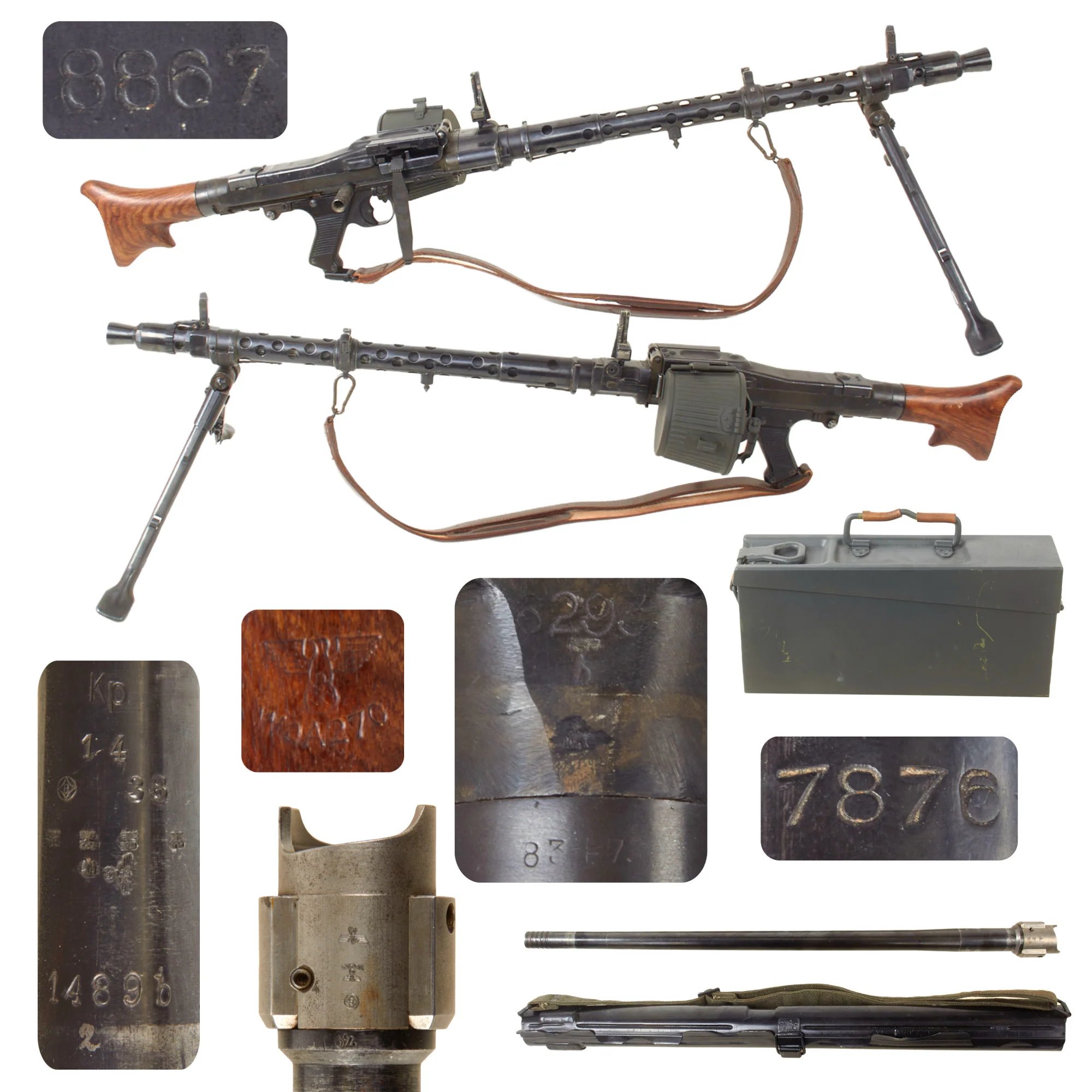
Original German WWII MG 34 Display Machine Gun Serial 7876 with Belt Carrier, Barrel in Carrier, Ammo Box, and Two Belts of Inert Ammo
Available
$4495.00
—
Description
Item DescriptionOriginal Items: Only One Set Available. Constructed from a legally demilitarized (de-milled) parts set, this is a wonderful and rare German WWII MG 34 Display Machine Gun. It is built from all original parts on an original BATF compliant non-firing display receiver, making this a 100% legal display machine gun. This receiver was created by using portions of the original torch cut receiver, including the barrel bushing, combined with some new made steel portions. It has properly had a 25% section of the total length completely replaced entirely with solid steel bar stock. Meaning a 1/4 length section of the display receiver is solid steel, making this legal to own without a license of any kind.This example comes with some wonderful accessories, which really add to the display potential. These included an original WWII marked and dated Basket belt carrier, a WWII Marked and Dated Barrel and Barrel Carrier, an original ammo can, and even two MG 34 / 42 ammo belts with inert ammo in them to complete the look. The items do look to have seen long service, so it is very likely that they have been refinished or refurbished in service, as the MG 34 so post war service for decades after the war ended.The gun in the set is one of our original WWII issue MG34 display machine guns, which bears multiple German wartime markings and has multiple Waffenamts. The barrel jacket looks to have been refinished at some point, and had the original markings mostly scrubbed. It was remarked with serial number7876, however we also noticed several WaffenamtEagle / 26markings on the barrel change joint, as well as farther down the barrel jacket. Every time we have seen these on an MG 34 barrel jacket previously, it was made by the legendaryMauser-Werke AG in Berlin-Borsigwalde. There are serial numbers and German proof marks on many other parts of the display gun.We were not able to see any maker codes on the top cover, which may have not been marked originally. It bears original serial number8867, with no remarked serials like we usually see. The latch mechanism on the end is marked withclc, the maker code forRichard Ab. Herder of Solingen, a maker of cutlery and tools in the legendary 'City of Blades', a known maker of feed trays and top covers for the MG 34. We checked the feed tray, and it is markedbpr, forJohannes Grossfuss of Dölbeln in Sachsen, a known maker of feed trays and top covers for both the MG 34 and 42.The bipod included is of the later war design, without the central height adjustment knob, and is in very good condition. It is maker markeddfb 1943on the central hub, next to anEagle / 4inspection stamp. This indicates 1943 manufacture byGustloff-Werke, Waffenfabrik, in Suhl, Germany. This company made many components for the MG 34 and MG 42, including entire guns. Attached to the gun is a lovely replicaGeteilte Trageriemen(Divided carrying sling), which makes it easier to carry around, and really adds to the display potential.The display gun really looks great, with a lovely blued finish overall. The front and rear sight still flip up and function correctly, and the bipod folds away and locks in correctly. The trigger is intact, moving back and forth, and the safety is present and movable. The belt drum fits well and locks into place correctly. The rear wooden butt stock is in excellent condition, and can still be detached from the receiver.The WWII marked basket belt carrier part of this set has been repainted with our correctpanzergraublue gray spray paint, as it was originally coated with many layers of post war apple green. It is marked on the lid withwa 43for 1943 production byHASAG-Eisen- & Metallwerke GmbH,Leipzig plant, previously known as Hugo Schneider AG, Abteilung Lampenfabrik, Leipzig. The carrier is fully functional, with a working side door and top closure. The ammo box has also been repainted panzergrau, and due to age and wear, we cannot see any markings on the top. It still has the correct leather padding on the handles. The included belts are both in great shape, and have dummy ammo loaded and attached starter tabs. We did note that while one belt is loaded with all 7.92 Mauser dummy rounds, the other looks to be full of .30-06, so it will not fit well inside the basket belt carrier.The spare barrel carrier is something that we do not see very often at all, and it is finished in black, which looks to be be blued or anodized on. It has a fabric sling still installed, however it may have been replaced post war. The carrier opens and closers correctly, and actually has an intactbrc 43marking on one end, indicating1943manufacture byFr. Weber & Co., located in Berlin SO36, Graetzstrasse 68. They were originally a manufacturer of lamps and lanterns, but their marking has also been found on shells and other ordnance. Next to this is what looks to be aWaffenamtWaA847inspection stamp. The spare barrel inside the carrier is lovely, and has an excellent bright bore, looking to have seen only light use during the war. It has a 38 date, multiple Waffenamts, and a small Rheinmetal-Borsig logo.A fine display MG 34 LMGs and one the very last we have to offer, complete with some fantastic accessories, just perfect for your collection!Please note that there may be various post-war markings on this display gun, in addition to the German WW2 markings. Many of these were acquired out of Israel, so many parts may have markings in Hebrew and 'Star of David' proofs.The Maschinengewehr 34, or MG 34, is a German recoil-operated air-cooled machine gun, first tested in 1929, introduced in 1934, and issued to units in 1936. It accepts the 7.92×57mm Mauser cartridge, and is generally considered the world's first general-purpose machine gun.The versatile MG 34 was arguably the most advanced machine gun in the world at the time of its deployment. Its combination of exceptional mobility - being light enough to be carried by one man - and high rate of fire (of up to 900 rounds per minute) was unmatched. It entered service in great numbers following AH's repudiation of the Versailles Treaty in 1936, and was first combat tested by German troops aiding Franco's Nationalists in the Spanish Civil War. Nonetheless, the design proved too complex for mass production, and was supplemented by the cheaper and simpler MG 42, though both remained in service and production until the end of the war.HistoryThe MG 34 was based on a 1930 Rheinmetall design, the MG 30. The Swiss and Austrian militaries had both licensed and produced the MG 30 from Rheinmetall shortly after patent. The MG 30 design was adapted and modified by Heinrich Vollmer of Mauser Industries. Vollmer modified the feed mechanism to accept either drum magazines or belt ammunition. He also increased the rate of fire. The MG 34's double crescent trigger dictated either semiautomatic or fully automatic firing modes.In the field, the weapon could operate in offensive or defensive applications. The offensive model, with a mobile soldier, used a drum magazine that could hold either 50 or 75 rounds of ammunition. In a stationary defensive role, the gun was mounted on a bipod or tripod and fed by an ammunition belt. Belts were carried in boxes of five. Each belt contained 50 rounds. Belt lengths could be linked for sustained fire. During sustained fire, barrels would have to be changed at intervals due to the heat generated by the rapid rate of fire. If the barrels were not changed properly, the weapon would misfire. Changing barrels was a rapid process for the trained operator and involved disengaging a latch and swinging the receiver to the right for the insertion of a new barrel. Accordingly, stationary defensive positions required more than one operator.The MG 34 was the mainstay of German Army support weapons from the time of its first issue in 1935 until 1942, when it was supplanted by the next generation Maschinengewehr 42 or MG 42. Although the 34 was very reliable and dominant on the battlefield, its dissemination throughout the German forces was hampered due to its precision engineering, which resulted in high production costs and a relatively slower rate of production. For its successor, the MG 42, the Germans instead used mass production techniques similar to those that created the MP 40 submachine gun. However, the Germans nevertheless continued widespread production of MG 34s until the end of the war.The MG 34 was used as the primary infantry machine gun during the 1930s, and remained as the primary armored vehicle defensive weapon. It was to be replaced in infantry service by the related MG 42, but there were never enough quantities of the new design to go around, and MG 34s soldiered on in all roles until the end of World War II. The MG 34 was intended to replace the MG 13 and other older machine guns, but these were still being used in World War II as demand was never met.It was designed primarily by Heinrich Vollmer from the Mauser Werke, based on the recently introduced Rheinmetall-designed Solothurn 1930 (MG 30) that was starting to enter service in Switzerland. Changes to the operating mechanism improved the rate of fire to between 800 and 900 rpm.The new gun was accepted for service almost immediately and was generally liked by the troops, and it was used to great effect by German soldiers assisting Nationalist Spain in the Spanish Civil War. At the time it was introduced, it had a number of advanced features and the general-purpose machine gun concept that it aspired to was an influential one. However, the MG 34 was also expensive, both in terms of construction and the raw materials needed (49 kg (108.0 lb) of steel),[citation needed] and its manufacture was too time-consuming to be built in the numbers required for the ever-expanding German armed forces. It was the standard machine gun of the Kriegsmarine (German navy).Shipping RestrictionsThis product is not available for shipping in US state(s): New Jersey, and WashingtonThis product is not available for international shipping.Payment OptionsNot eligible for payment with Paypal or AmazonLegal InformationThis item is completely legal within the USA. International Military Antiques, Inc observes all Federal, State and Local laws. Everything for sale on ima-usa.com is completely legal to own, trade, transport and sell within the United States of America. Every display machinegun and machine gun parts set and gun sold by IMA, Inc is engineered to be inoperable according to guidelines provided by the US Bureau of Alcohol, Tobacco, Firearms and Explosives (BATF). Please note that the requirements for each display gun are decided on a per case basis by the BATF, and may require deactivation of omission of some internal components. For more information on this display gun, please contact us. Not available for Export.